Today is Columbus day. I’m sure we all learned it in school: “In 1492 Columbus sailed the ocean blue.” That’s probably the only true part of the story we were told.
He didn’t do it to prove the world is round, as that was already pretty widely accepted at the time. He did it to find a sea-based trade route to China. And he didn’t “discover” America. A) The Natives technically discovered America first, and B) Even other explorers, like Leif Ericsson for example, got here first, and C) At best, he landed in The Americas, not North America. And even after he arrived in the Americas, he refused to believe he hadn’t actually reached Asia, despite his utter inability to find any of its great cities. And on top of all that, he was kind of a terrible person and a horrible racist, and his “discovery” unleashed all kinds of horrors on the so-called New World, with the men under his command raping and robbing the natives, and ultimately enslaving them. He even took natives back to Europe as a sort of “show and tell” (because of course, he didn’t think they were really human), and many of them didn’t even survive the voyage.
And before we excuse him based on the fact that tons of people of his time found his behavior, and the behavior allowed under his command, perfectly acceptable, I have to mention a guy truly worth celebrating today. Bartolome de las Casas. De las Casas was originally a participant in the system of exploitation that was quickly set up under Spanish rule in Hispaniola, but he later became a priest, and became convinced that this exploitation was contrary to his Christian faith. Now, this was truly unique, as everyone at the time was a Catholic, and here he was telling them that they were all wrong, and that they were understanding this Jesus guy all wrong. De las Casas became an advocate against slavery, and largely thanks to his work, Pope Paul III forbade slavery in 1537 (shocking how much earlier that happens than it did in the US), and Emperor Charles V followed suit in 1542.
Here are some of the horrors de las Casas saw in the New World that made him such an anti-slavery advocate:
The Spaniards did not content themselves with what the Indians gave them of their own free will, according to their ability, which was always too little to satisfy enormous appetites, for a Christian eats and consumes in one day an amount of food that would suffice to feed three houses inhabited by ten Indians for one month. (37)
The most powerful ruler of the islands had to see his own wife raped by a Christian officer. (37)
They attacked the towns and spared neither the children nor the aged nor the pregnant women nor the women in childbed, not only stabbing them and dismembering them, but cutting them to pieces as if dealing with sheep in the slaughterhouse. (37)
They made some low wide gallows on which the hanged victims’ feet almost touched the ground, stringing up their victims in lots of thirteen, in memory of Our Redeemer and his Twelve Apostles, then set burning wood at their feet and thus burned them alive. (37)
With still others, all those they wanted to capture alive, they cut off their hands and hung them around the victim’s neck, saying ‘Go now, carry the message,’ meaning, Take the news to the Indians who have fled to the mountains. (37)
It’s enough to make you sick at your stomach, right? What Columbus unleashed on the New World is not worthy of celebrating. He should not be made into a hero for children, because he was a corrupt man pursuing his own wealth at the expense of the lives and suffering of others. Instead, we should celebrate people like de las Casas, who came to realize what he was participating in was deeply deeply wrong, and took action that actually led to change. That’s so much more exciting and rare than a Columbus Day Sale.
All quotes come from Bartolome de las Casas’ “The Devastation of the Indies” in the Norton Anthology of American Literature, Seventh Edition, Volume A.
So, you may have noticed that the blog has been quieter than usual. It’s because I’ve been keeping some really big news under my hat, and I’ve been unable to even think of anything else, let alone write about anything else. And today that news got bigger and crazier, and though we were planning to wait a little longer for the reveal, we just can’t keep this in. So, we’re telling the world…
THAT WE ARE HAVING TWINS.
I’m not kidding, I’m not joking, and no, I don’t even believe it, but the doctor tells me the two fuzzy blobs on the screen are in fact two babies. Two babies that I will be birthing in April. Holy crap. Totally insane. What was already giant, life changing, you will never sleep again news has now doubled.
In case you doubt me, or you enjoy looking at fuzzy blobs on ultrasound images (if you don’t, that’s cool, I never know what I’m looking at and find ultrasound images a little weird, myself), here is my proof:
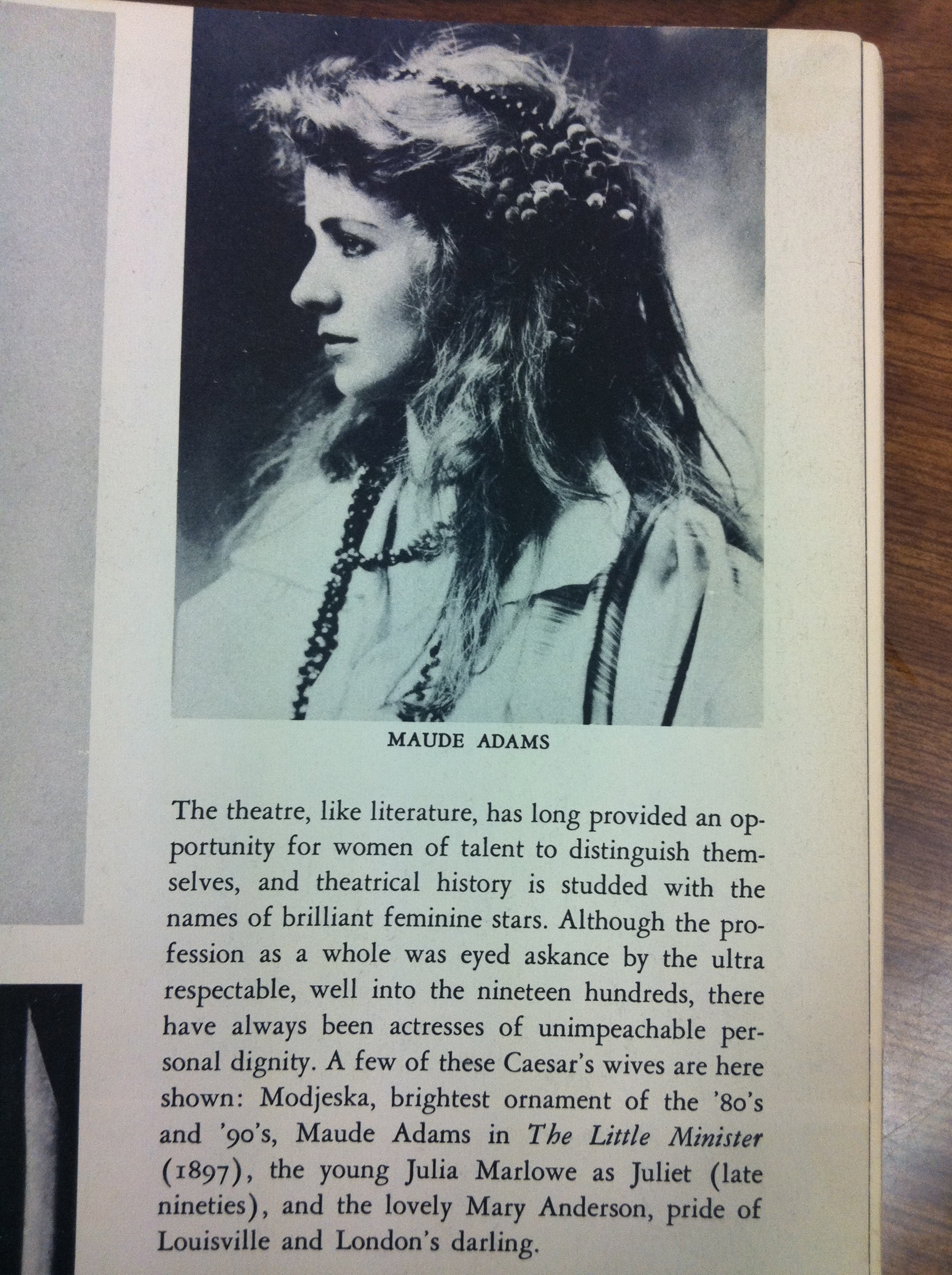
I spend a lot of time hanging out in my university library between classes. Usually I’m busy looking over materials for class, or checking in with my internet world, but sometimes I let my eyes wander over the shelves wherever I’ve settled, just to see what catches my eye. Recently, a tall book caught my eye, its title visible over the tops of all the other books: Women are Here to Stay. “Of course we are!” I said to myself, “Where else could we go? Who could manage without us?” I pulled the book off the shelf and read the subtitle: “The Durable Sex in its Infinite Variety Through Half a Century of American Life.”
Intrigued by this strange title, I opened the book, and realized it was a book of pictures. Often, hilarious pictures.
This lovely lady wore this cat hat as a costume at the Vanderbilt Ball.clearly badasses.
But it turns out, published in the 1940s, this book had a feminist mission. One which is sadly still necessary today. Check out the introduction and see if you can relate:
The American woman today must be an expert housekeeper…She must be a wise, conscientious, and loving mother, always there when her children need her, but standing aside when her presence might threaten the full development of their individuality. She must be a delightful, helpful, thrifty wife, ready to administer comfort or to share in gay adventure. She must be a useful member of the community, informed on broad political trends as well as possible danger spots in the local school boards. She is also a citizen of the world and should be able to name the current President of France, have constructive ideas on what to do with the atom bomb, and say what’s wrong with our foreign policy.
That isn’t all. She is expected to read, look at, listen to the important new books, pictures, music, for women are the traditional guardians of culture. If she’s young, she should be cultivating some interest against the time when the children don’t need her. If she’s old, she should be happily occupied in some moderately useful, unspectacular fashion, keeping herself decently to herself, and not interfering with her juniors and betters.
And at all times, and at all ages, she should be, if not actually beautiful, as good-looking as perfect grooming, a disciplined figure, and good clothes can make her. (This part is very easy. The advertisements tell you how.)
It would not be surprising if women gave up entirely, crushed by the barrage of abuse and advice, and paralyzed by the impossible goals set for them. They don’t though. They keep on living–longer than men, as a matter of fact. It is indeed a durable sex.
Now, in nearly all books about women, the authors assume that women think and act first of all as women, not as individuals, and this assumption leads into the habit of thinking that they’re all pretty much alike. It is my intention to demonstrate that there are a great many different kinds of women (just as there are a great many different kinds of men) and that it is impossible to generalize about them– tempting though this may be, and very good fun as a pastime. (1)
On the one hand, this is laughable– of COURSE women are all special snowflakes, individuals, whose allegiance is first to ourselves and then to our sex. But is this not still our struggle? To be our individual selves, despite the monolithic mold that seems determined to bend us into some sort of ideal woman?
This gorgeous lady would be at home on a red carpet today.
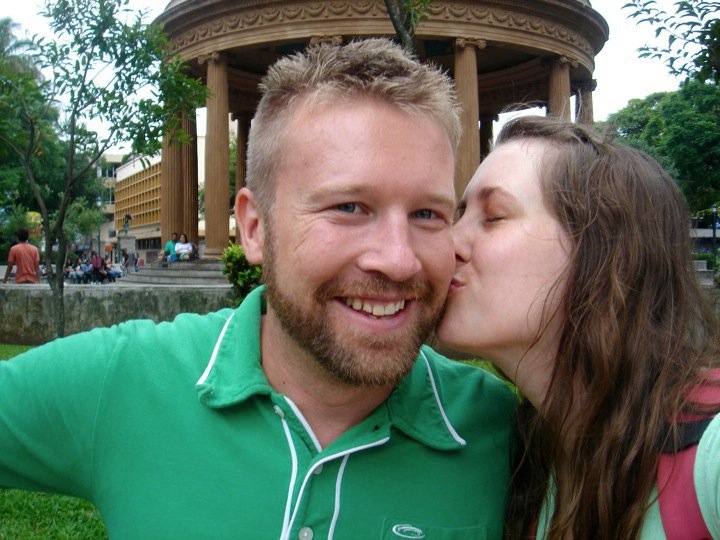
Because we were in Costa Rica for our anniversary, I didn’t get to do a postlike I usually do on July 29th commemorating 5 years of marriage to Jon. But, we got to be in Costa Rica for our anniversary, so that’s pretty awesome. We constantly talk about the kind of life we want together “someday” when he’s finally done with medical training and I’m finally done with school, and in looking at the kind of goals we set for ourselves: simple living, being generous with others, living in a way that is good to the environment, we’ve realized that the people we were 5 years ago wouldn’t be having these sorts of dreams for the future. We’ve changed a lot in our time together, which I guess is to be expected when I met my true love at the age of 18 and got married at the ripe old age of 21 (Jon’s 5 years older). I think we’ve both changed each other for the better, and I’m sure there’s lots of change still ahead of us. I’m sure glad we can keep growing together, forever. I know I can face anything as long as I’ve got my best friend by my side.
On a bench in a park in downtown San Jose. Everywhere we looked, couples were making out in public. That's not quite our style, so this was our contribution.
Ignoring the cheesy images, here’s a song to dedicate to the one I love, “Loving a Person” by Sara Groves, a favorite of mine:
10 bonus points to the person who knows where the title of this post comes from. This is a long story, but I hope it will bless you as much as it has me.
As I mentioned yesterday, my husband somehow left his iPhone in San Jose, Costa Rica, on the last day of our visit there. This last day, I must say, can barely be considered a day. We arose around 3:30 in the morning. Possibly the only thing that got me out of bed that early was that our awesome AirBnB host had promised coffee and breakfast would still be ready, even before the actual crack of dawn, and so I dragged myself out of bed, did my last bit of packing, and enjoyed fresh bananas with granola, and home baked bread, and some of the most delicious coffee in the world. We were in a bit of a rush to eat breakfast, get a taxi, get to a bus stop, and take that bus to the airport in order to arrive by 4:30 am for a very early flight. With steps 1 and 2 completed, we were in the taxi almost to the bus stop when Jon noticed he didn’t have his phone with him. I remind you at this point that it was insanely early in the morning, and we may not have been thinking clearly. He checked his backpack and his pockets, and didn’t find the phone. We figured he had left it by the computer he was using at the casa right before we left, and pondered if we could go back for it, but realized we couldn’t if we wanted to make our flight. We decided we would have to email our hosts when we got back to the States and see if they could send it back to us.
As we rode the bus to the airport, we saw many pilgrims walking along the sides of the road to a city in Costa Rica called Cartago. An estimated 2 million people all over the country were walking, many for days, to reach this city in order to show thanks to God for their blessings, and, for many, to ask for healing. Our friends in San Jose had told us of a man in the papers who had already received the miracle of being healed of his blindness during this year’s pilgrimage. Seeing them walk along the road, carrying only small backpacks, in the wee hours of the morning was a great blessing. I’m not sure I can really explain why, but their devotion and dedication and sacrifice touched my heart, and as we roared past each little group in our great big bus, I said a little prayer that God would bless them for their faith. God certainly blessed me with their faith.
We made it onto our plane and eventually arrived home in Arkansas. Here is where I also pause to mention that it is difficult to secure a ride home from the airport without a phone, especially now that airports, realizing that most everyone has a cell phone, have eliminated pay phones. And, in the event that one does manage to find an actual payphone in actual working order, who still has any phone numbers memorized that he or she could call? Not us! A taxi home was the way we had to go, as we were weary and absolutely could not face the prospect of yet another bus.
We finally arrived home, and Jon emailed our hosts explaining the lost phone situation. We then headed to church, happy to connect with our friends there after a week away. That night, Ryan preached on what is commonly known as the Golden Rule, from Jesus’ Sermon on the Mount. We discussed how that verse marks a transition, where Jesus turns from speaking about our relationship with God (“ask, seek, knock”), to our relationship with each other, a relationship that should be characterized by us doing what is good and loving to others, even when, and perhaps most especially when, it is no guarantee that this goodness and love will be returned. We do not participate in goodness and love in order to receive it, but because when we participate in goodness and love, we participate in the very character of God, a character perhaps best illustrated in the Parable of the Prodigal Son, in which God is radically UNfair, bestowing love and goodness even when it is least deserved.
The next morning, Jon received an email from our hosts Darrylle and Juan Carlos telling their side of the story of the lost iPhone. I asked for their permission to share this story:
As soon as we received your message we searched the house and found no sign of your iphone. We were so sad for you as we knew that if you’d lost it in the street or in the taxi or bus that there would be only a chance in a million that we could find it. We called the number to see if we could hear it ringing somewhere in the house or if someone would answer. After many rings a woman answered and when Juan Carlos spoke with her she asked if the phone was his. He told her that it was and she said that we could pick it up. She lives high up in the mountains near Turrialba about 2 hours southeast of San Jose.
We jumped in the car and headed toward the area. The road to Cartago was packed with pilgrims walking in the rain and it was amazing to experience their dedication and determination. By the time we got to her area it was dark and raining. After seeking information from people along the road and calling her on numerous occasions, we finally found her standing in front of a small shanty along a little road way off the main highway deep into the countryside. She is a single mother working nights in San Jose and takes this long two hour trip daily. She had found the phone in the back of the taxi about 5 a.m., at first thought of giving it to the driver, but then had second thoughts. She said she knew if she gave it to him he would make no effort to find its owner. Throughout the day she told several people she had found the phone and received several offers to buy it. Of course, she could have used the money, but decided that she would keep it for several days and if the owner didn’t appear that she would then sell it.
When we met her along side the road, she just walked up to the car window and handed us the phone and didn’t ask for anything. Unfortunately, we’d left the house in a hurry so I only had ¢10,000 ($20), so I gave it to her but she seemed happier to have found the owner than to have received the money. It was a blessing to be in the presence of this sweet, happy, honest and caring woman. Juan Carlos and I had spent time together yesterday morning, as part of our daily spiritual practice, discussing how if we keep our minds in synch with thoughts of goodness, if we hold the intention to bestow rather than to receive, if we focus on our true Self rather than our illusionary ego, that miracles will appear. As we reached the main road to return to San Jose we simultaneously expressed our realization that we had just experienced a miracle and our minds filled with light and joy. Everybody gained, there was no loss and each and every one of us received a blessing of love. Thank you so much for providing the opportunity to experience God in our lives. It was amazing.
Amazing indeed. Jon and I both choked up as we read the email and realized what a miracle this was. Sure, it’s just a returned iPhone. Why would God care about such a thing when there are literally blind people walking to Cartago in need of sight? Because this story is not about the iPhone, but about the goodness at the heart of people everywhere. I personally believe this goodness is the image of God. It’s the goodness that inspires someone to get up insanely early to send a traveler off with a good breakfast. It’s the goodness that inspires people to walk for days and days in order to say thanks and perhaps beg for a miracle. It’s the goodness that inspires people to drive for 4 hours for someone else’s phone. And it’s the goodness that inspires a woman living in poverty to do someone a great kindness, even when doing the opposite would help her provide for her children. It’s the goodness that lies at the heart of the God of the universe, a goodness that lives inside each one of us, if we choose to honor and nurture the image in which we are created.
I needed a reminder of this goodness. When we arrived in Atlanta, it was a rude welcome home to the States. The customs agent who checked my passport said something very ethoncentric about people who speak other languages. The man in front of me in the security line acted absolutely beastly to everyone he encountered. And my personality is such that I often tend to dwell on those people who don’t nurture their inner goodness, rather than those who do. And yet, here in front of me, here in my life, I have been given a miraculous reminder of the nature of God and the true nature of all God created and declared good. And I am so truly thankful.
My husband Jon was recently part of a team that went to Haiti to run clinics. Since many of this blog’s readers supported the trip financially and through prayers, I thought you might like to read about the trip in his words. Here’s his story:
I have no idea how to best convey what I saw and experienced in Haiti. Had this been my first experience in a 3rd world country, I believe I would have been balled up crying after the first day. I have seen dire poverty before, but nothing close to what I saw in Port-au-Prince. Really, unless you personally go there, it is impossible to get an idea of what is going on. But I will try to paint a picture.
The enormity of the problem and the reality of the hundreds of thousands of displaced Haitians hit home on our approach to the Port-au-Prince airport. Looking out over the city, as far as I could see were tiny tops of “houses.” By this I mean strung tarps mixed in with battered, rusted tin roofs. At that point, the discussing and planning mode instantly changed into a “oh my gosh, what have I gotten myself into” mode. I was also afraid of what demands customs would make of us to get our medications through customs, but our translator Chris ended up finding a customs agent who knew one of the doctors he worked with in Haiti, and he allowed us to walk right through customs without even a peek into our bags. Hurdle number one jumped.
No matter where or when you drive in Port-au-Prince, the streets are overflowing with people walking, motorcycles zipping through tiny spaces, buses, tap-taps (any kind of large, brightly painted vehicles available for transportation, and you ask to get off by tapping, get it?), merchants and cars, making for a loud, exciting time. The one thing there isn’t a lot of is traffic laws. Who knows what the laws are, there are no lines on the roads, few stop signs and few lights. It’s a miracle there aren’t more accidents. Also, in the streets is all kinds of rubble. Yes, it has been over 18 months since the earthquake, but rubble is everywhere, and even the presidential palace and great cathedral remain in ruins. According to those who live there it is much better than after the earthquake, which I believe, but it was still overwhelming. There were even many partially collapsed buildings that were empty, and probably haven’t been searched for bodies due to the danger of collapse while searching.
A Haitian tap-tap.
On day 2, we finally got to run a “clinic.” We met with Dr. Jeudy, a friend of our hosts, who is in the process of building a new hospital/operating room. We met in his current office, with two crampeded exam rooms, a crowded waiting room, pharmacy and lab on the first floor, an operating room and two large rooms he’s using as inpatient wards on the second floor and living quarters for nurses, as well as a room he sometimes sleeps in on the third floor. He and I saw and admitted a woman with severe pneumonia and respiratory distress before heading to his new site that consisted of concrete floors and some walls where he’s building a new office. We hadn’t advertised the clinic, as he was afraid we didn’t have enough medication, so he told me, “we’ll see people as they come, they’ll probably trickle in, and we’ll start with a slower day.” Ha. As soon as we set up, we were flooded with patients, and between me, him, and a couple ofmedical students, we saw over 270 patients before we had to shut down and turn people away due to impending darkness.
Speaking of darkness, currently in Port-au-Prince, electricity is available for 12 hours a day, and I can only assume it’s some guy’s job to turn off the power. On about half the nights, about 30 minutes after the electricity went off (about 8pm), the power went back on for the night. When it came back on, a loud raucous roar could be heard throughout the city, celebrating a few more hours of light. Some early mornings (like 4am) also consisted of a loud singing/dancing/parade type thing that we were told was a voodoo celebration. Didn’t check it out, but we were all curious.
A patient with mumps.
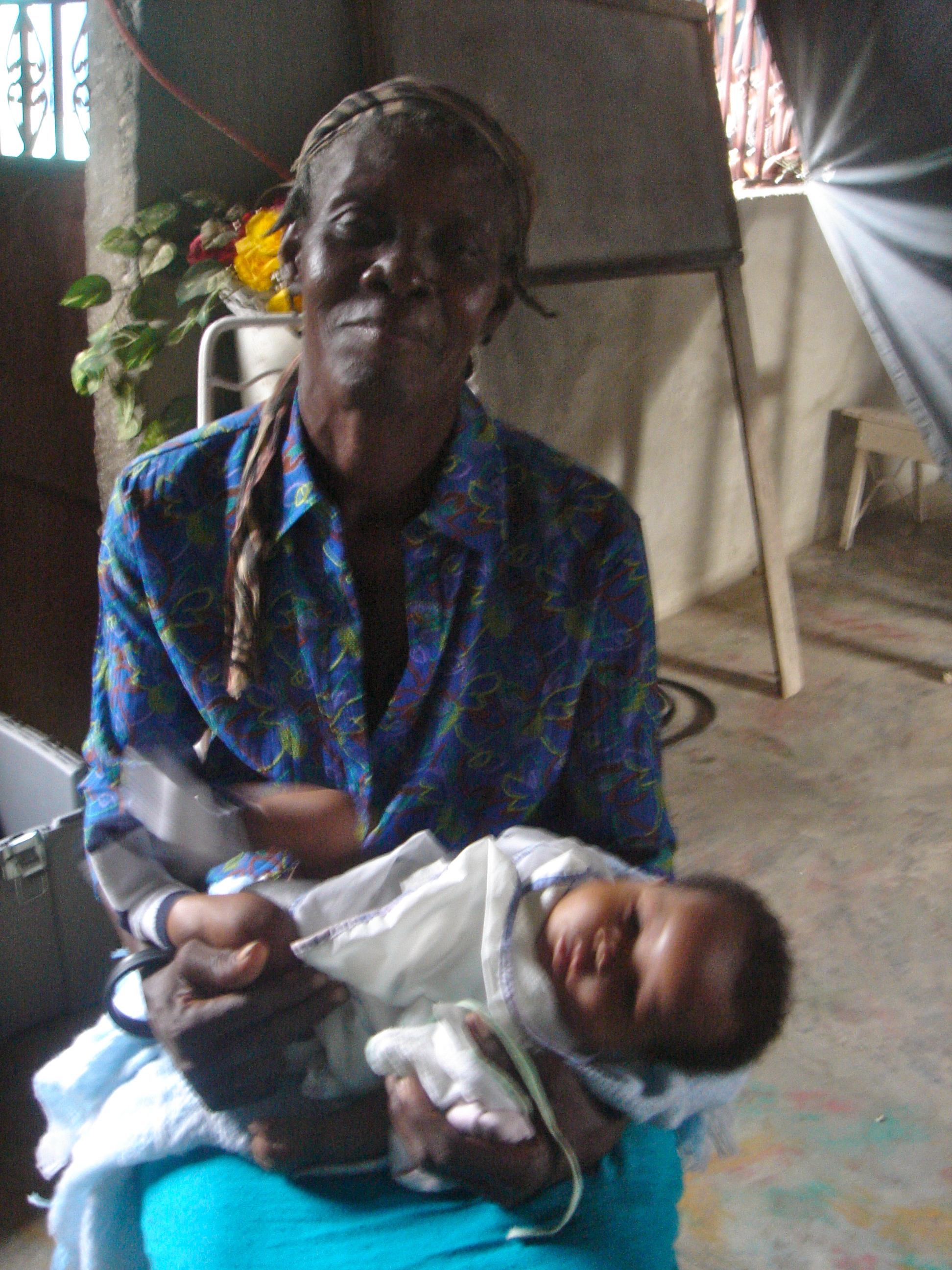
We ran 5 more busy days of clinic, 2 more in the city, and 3 on the outskirts of town. We mainly saw headaches, abdominal cramps, menstrual cramps, reflux, pneumonia, yeast infections, ear infections, colds, arthritis, high blood pressure…much like you would see in a primary care clinic in the States. However, nobody had glasses (probably accounted for many headaches) and they couldn’t afford to buy pain relievers, cough syrup or antacids. We gave all the kids tooth brushes and many of them vitamins, and presumptively treated worms, malaria (for anyone with high temps and flu-like symptoms) and cholera (all severe GI symptoms.) While running a clinic in the schools, I saw a child with epilepsy who had already seen a doctor, who had recommended seizure medicines, but she could not afford them. We didn’t have any medication for that either, so had to just give advice: don’t swim, drive cars, climb trees, etc. and support the airway when she had seizures. Very frustrating not to be able to treat, but we couldn’t take everything with us. We also saw several kids with mumps (I hadn’t seen that before), measles, and lots of tinea capitis (ringworm on the scalp). I sent one dehydrated, lethargic 11 day old to the hospital for care we couldn’t give, and kept one 4 month old in the clinic for a couple hours to hydrate orally when we found him to be lethargic with a >200 heart rate. He seemed to perk up after fluids! One older lady had stepped on a rusty nail, and was beginning to show signs of tetanus-I excised the wound, started her on Flagyl and told her to find a hospital for further care.
Patient showing signs of tetanus.
While brainstorming about ideas to help this poor country, we discussed different things people have tried, but lead to further problems, often due to the Haitians’ hand to mouth living situation, a situation created, nurtured, and sustained by the West since the colonial days. One example: Although there are chickens and goats roaming free everywhere, all the chicken, eggs and goat’s milk you buy in Haiti is imported from the US. When one group took small laying hens to the country to try and set up an egg farming operation, they explained that the people shouldn’t eat the hens, because they would provide many eggs, they returned the next week and found the hens were all eaten. This may sound crazy, but it’s understandable that people with no idea where their next meal is coming from might prioritize short term relief over a long term solution that may or may not work out. After the earthquake, many Non-governmental organizations came to town to provide free medical care. The people came in such numbers that many local hospitals could no longer stay open, as people no longer wanted to spend money on medical care because they could get free care from the NGO’s. Some aid creates more harm than good, because it prevents local, sustainable solutions from becoming viable.
goats in Haiti
Due to US trade embargoes placed on Haiti due to coup-de-etats, multiple factories shut down, leaving the workers jobless. It seems that no matter what is tried, there is an opposite reaction that minimizes or reverses the impact that you’re trying to achieve. It’s a very frustrating mind game for sure. The island is beautiful, it’s in the Caribbean, and would have lots to offer if things turned around some, but getting there is difficult.
So, the trip was gratifying, knowing we provided a small amount of medical care to those who would have gone without, but frustrating, seeing vast need going unmet for a majority of Haitians. It is going to take many smart people, lots of money and a long time to reverse both the damage done within a few minutes of time with the earthquake, and the problems created by generations of Haitians living day to day, not knowing where their next meal will be, nor where they will sleep that night. The only lasting solutions will be ones that empower and involve workers, not through hand-outs and band-aids, but through sustainable programs that allow Haitians an active role in the repair and renewal of their nation.
Now that Tinycat is staying, I decided he needed a nicer bed than a folded up beach towel. To the folks wondering, “how do you get your cat to sleep on a designated bed in the first place?” the answer is, he sleeps locked in the bathroom off of our bedroom, so he basically sleeps on the softest thing in there.
I started looking at cat beds online, but they were all kind of boring, slightly ugly, and $20-$30.
I wanted something cuter, and with my rudimentary sewing skills, figured I could make something decent for less than $30. I went to Hobby Lobby and assembled the following supplies:
Foam square: $4.89 (on sale, regularly $6.99), 1 yard of fabric: $8.99, 1 spool of matching thread: $.99, zipper: $2.29. Grand total: $17.16.
Then I basically laid the foam down on the fabric and cut around it, leaving about half an inch on each side as a seam allowance. I did this for each side of the cushion. For one of the long sides, I cut double the seam allowance to allow for the zipper to be installed, because I wanted the cover to be removable so I can wash it. I installed a zipper in the middle of the long sides, sewed the sides together end to end, leaving one side unsewn, and then started attaching the sides to the top, working my way around until all the sides were sewn on, and then sewing the last corner. Then I sewed the bottom on, turned it right side out (thanks to the zipper, this was possible), and put it on the cushion. I made sure to finish all my seams nicely so that they won’t unravel in the wash.
This is the final result (related: it’s hard to photograph a cat on his cute new bed when all he wants to do is eat the bed):
Crazy cat in action.View of the zipper side.
It’s not perfect at the corners, and the fit could be slightly tighter, but overall I’m pretty proud. Also, notice how it matches those pillows on our bed? When it’s not eleventy billion degrees, that’s also what our duvet cover looks like, so Tinycat’s bed looks like a mini version of ours. So cute I could die.
I could be convinced to make one of these again for someone I loved for compensation or a Christmas gift, and if that happens, I’ll try to take some step by step photos so this post is more helpful.
So…Tinycat still lives here. We got a new home all lined up and then, while I was all “trying to be strong and do the right thing,” Jon decided we just couldn’t part with him.
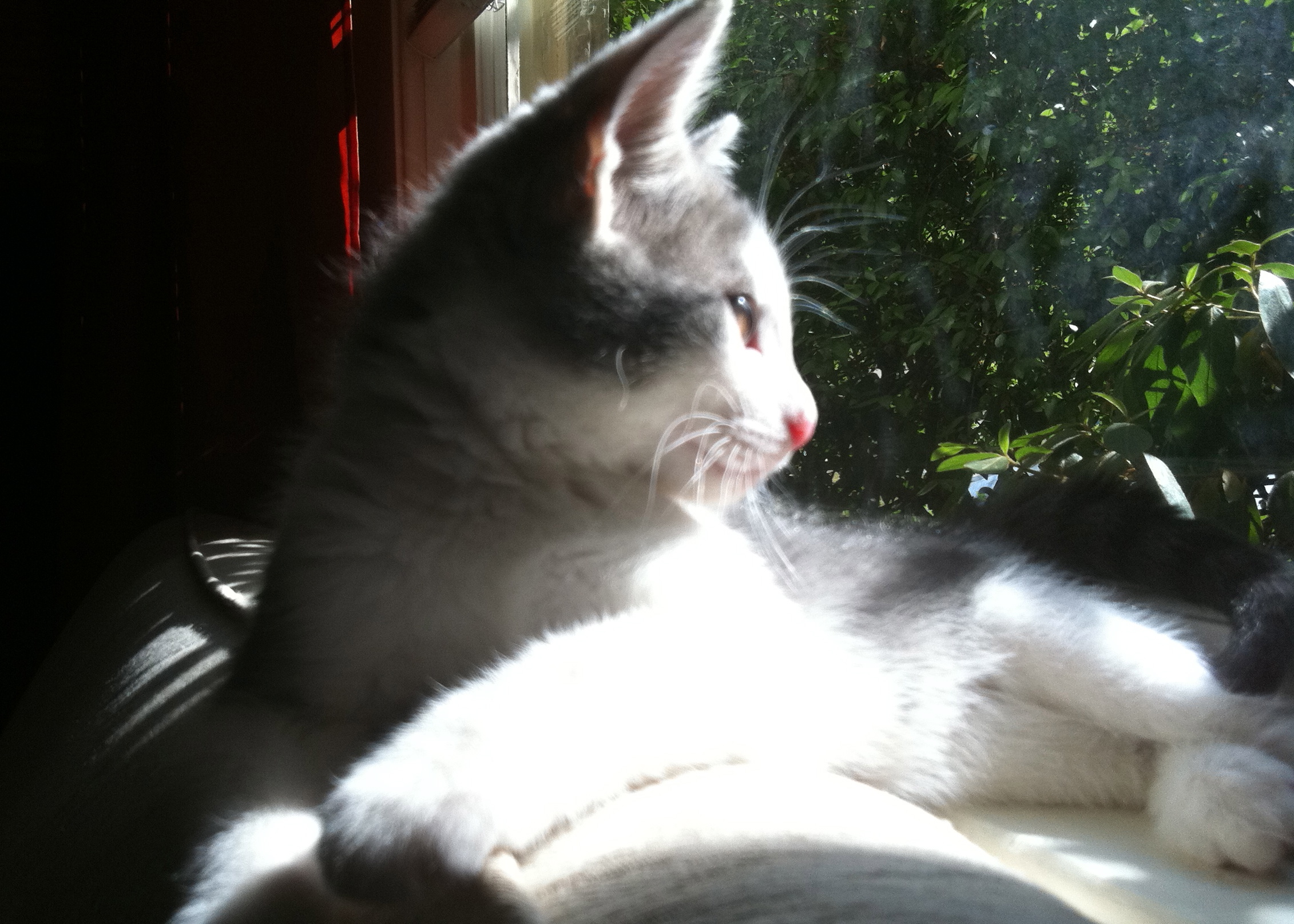
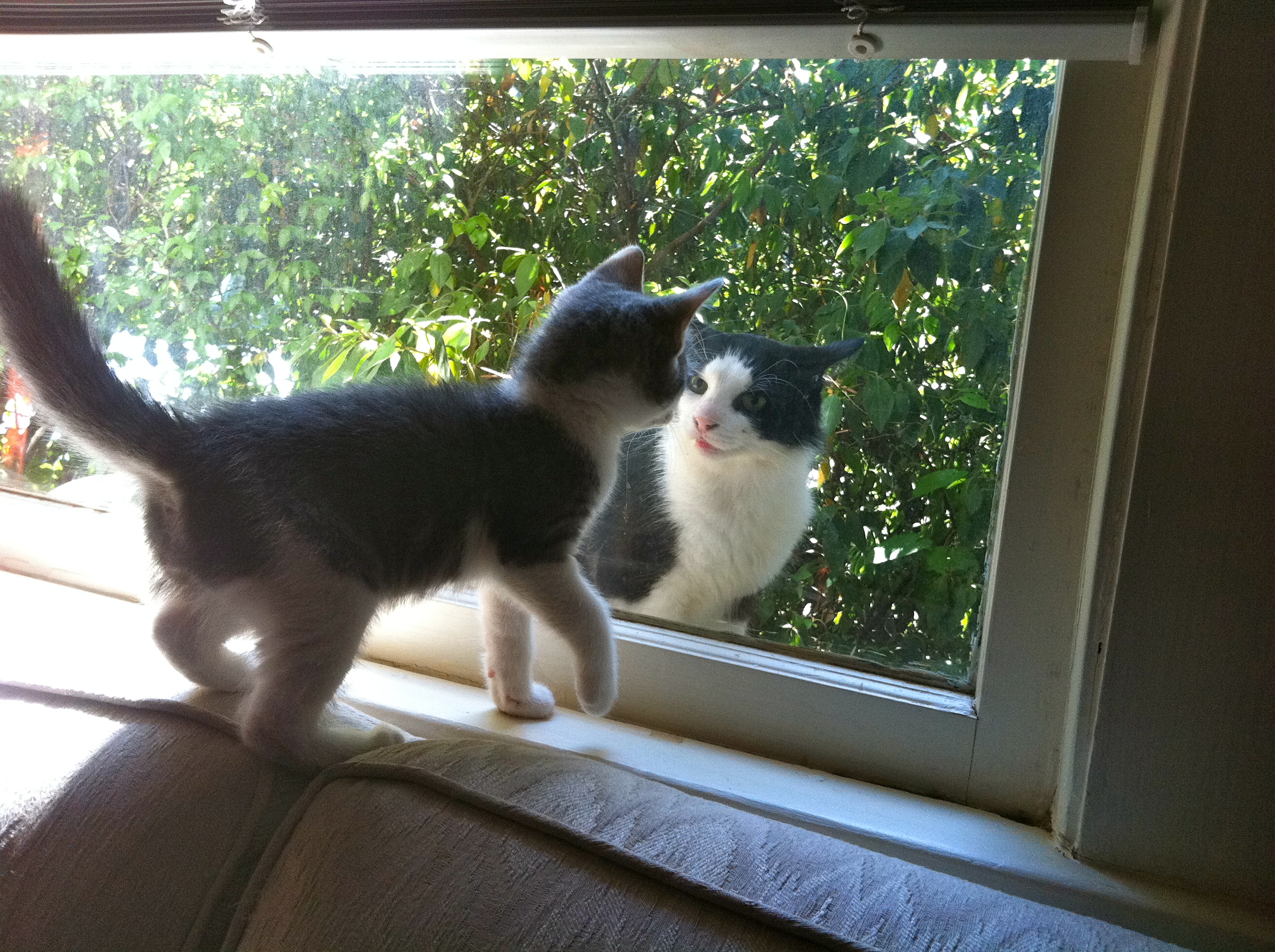
The other morning, we were doing our usual morning routine, which involves me internetting and drinking coffee while Tinycat hangs out on the back of the couch/on the windowsill. He likes to bask in the sun like so:
While he was basking, a stray cat outside (our neighborhood is full of strays and semi-strays that seem to have owners who don’t keep them inside, ever) spotted him and popped up on the window ledge to say “hi.”
And then this ensued:
I think he really wanted to go out and play! A friend wondered if they were related, but that’s probably pretty unlikely as Tinycat was found way downtown and this cat lives around here. Now if only our dogs were as calmly curious and playful as that stray cat, we’d be getting somewhere!

 Today is Columbus day. I’m sure we all learned it in school: “In 1492 Columbus sailed the ocean blue.” That’s probably the only true part of the story we were told.






















 erniebufflo's south & west kitchen