Jesus and Gender Part 4: Women Disciples

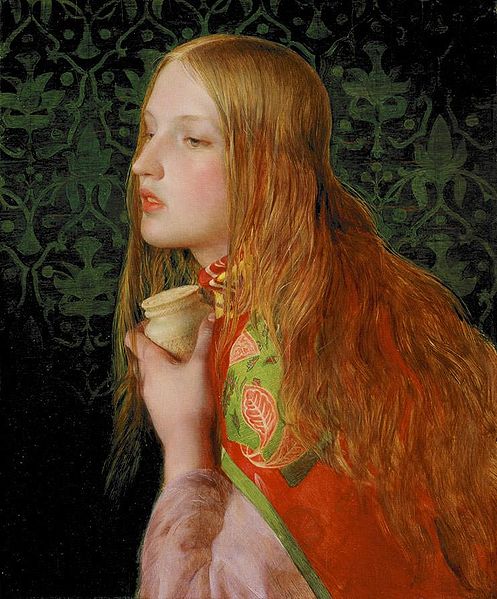
Mary Magdalene, painted by Anthony Frederick Augustus Sandys.

Today is day 4 of my series on Jesus and Gender. Make sure to catch up with Part 1, Part 2, and Part 3 if you missed those posts!  We’ve discussed how Jesus treated women with radical dignity and kindness, we’ve talked about his close female friends, and today we’re going to look at the women who were his disciples.

Although we are most familiar with The Twelve Disciples, all of whom are men, Jesus had more than just 12 disciples, and these disciples included women. (Also, from Woman in the World of Jesus: “The logic from which the male composition of the Twelve would exclude women from high office or role in the church would likewise exclude the writers and most of the readers of this book, for there were no non-Jews among the Twelve. Unless one would argue that “apostolic succession” is for Jews only, it cannot be for men only.” (125))

Jesus had a large group of followers who went with him all over Israel, learning from him and following in his ways.  According to Luke 8:1-3: “After this, Jesus traveled about from one town to another, proclaiming the good news of the kingdom of God. The Twelve were with him, and also some women who had been cured of evil spirits and diseases: Mary (called Magdalene) from whom seven demons had come out; Joanna, the wife of Chuza, the manager of Herod’s household; Susanna; and many others.  These women were helping to support them out of their own means.”

While women at this time were permitted to travel in the company of men, they were required to spend the night only with their relatives—here it is obvious that as they travel from city to city, the women are traveling along with the men, breaking social custom in a very progressive and scandalous way.  Secondly, these women had resources under their own control at a time in which women were generally not permitted to inherit property or control money.  So not only did Jesus have women among his disciples, but they were transgressing social norms and acting as the bankers of the whole operation!

And these women weren’t just hangers on; they were actually ministering with Jesus! According to Frank and Evelyn Stagg in Woman in the World of Jesus: “It is significant that women did have an open and prominent part in the ministry of Jesus. Luke’s word for their ‘ministering’ is widely used in the New Testament, including by Paul in reference to his own ministry. Its noun cognate, diakonos may be rendered ‘minister,’ ‘servant,’ or ‘deacon.’” (123)

One of these women was Mary Magdalene. Nowhere in scripture is she identified as a prostitute or even a great sinner.  Mark says that Jesus drove seven demons out of her—today we might say that he healed her mental illness.  From Elisabeth Moltmann-Wendel’s The Women Around Jesus: “We may imagine that this cure took a similar course to other healings: Jesus touched her, perhaps embraced her, made her get up, like Peter’s feverish mother-in-law or the person possessed by demons.  He spoke to her and she had a tangible feeling of nearness and contact. As he spoke, the spell left her. She again became herself, free to feel and decide, free once again to experience the world around her, free to enjoy herself and to learn to live again. But she did not return to her old ways. She left her rich hometown of Magdala, even though she would always bear its name. For her, being healed of her illness became salvation.” (68)

Another woman mentioned among these disciples is worth considering: Joanna, wife of Chuza, who was an officer in King Herod’s court.  She is described here having been healed by Jesus, after which she began traveling with and supporting Jesus financially, and she is later present at his crucifixion, and, in at least one gospel, at his resurrection. Jesus was seen as a political enemy of the political establishment, a revolutionary threatening to overthrow the government, and here, the wife of a government official is hanging around with and supporting this revolutionary and traitor of the state, helping to support him financially.  It’s possible that Joanna’s husband had died and left her widowed and in control of his estate, but it’s also possible that she had left him, with or without his blessing, to follow Jesus.

These women disciples were with Jesus to the end, present at the crucifixion, in some cases acting with more bravery and loyalty than The Twelve, who fled and feared for their own lives.  From Mark 15:40-41: “Some women were watching from a distance. Among them were Mary Magdalene, Mary the mother of James the younger and of Joseph, and Salome.  In Galilee these women had followed him and cared for his needs.  Many other women who had come up with him to Jerusalem were also there.”  –In Mark’s account, the oldest of the four gospels, the disciples are not present at the crucifixion—they run away after Jesus’ arrest and are not said to have returned. Similarly, in Matthew’s account, the disciples have run away and only the women are present at Jesus’ death. From Luke 23:49: “But all those who knew him, including the women who had followed him from Galilee, stood at a distance, watching these things.”  John 19:25-27: “Near the cross of Jesus stood his mother, his mother’s sister, Mary the wife of Clopas, and Mary Magdalene.  When Jesus saw his mother there, and the disciple he loved standing nearby, he said to her, ‘Woman, here is your son,’ and to the disciple, ‘Here is your mother.’ From that time, this disciple took her into his home.” Even as he suffers pain and death, Jesus is surrounded by the women who followed him, and he is exhibiting concern for their welfare.

And these women weren’t just there at Jesus’ death, but played a very special role in the events of the Resurrection. In Matthew, after his resurrection, Jesus chooses to appear first to two women, Mary Magdalene and “the other Mary (possibly Mary of Bethany)”  Jesus trusts them to go and tell the men that he is risen, even though at this time, women were considered so unreliable that they couldn’t even testify in court.  Still Jesus trusts them with this important news. In Mark’s account and in Luke’s account (which also names Joanna), the disciples do not even believe Mary Magdalene/the women.  In John, Jesus only appears to Mary Magdalene, and she calls him “Rabboni” which suggests her status as one of his students. According to The Women Around Jesus: “Mary Magdalene may be regarded as the first apostle. She was the first to proclaim the gospel of the risen Christ.” She was considered an apostle, someone commissioned by Jesus with a special mission or message, up to the Middle Ages.

So, not only was Jesus radically inclusive of women in even his most passing encounters, not only did he have close personal friendships with women, but he had women among his disciples and even accorded them the honor of being the first people in the Bible to preach what we know as the gospel, the good news of his resurrection.   Tomorrow we’ll look at the women who were apostles, deacons, and prophets–leaders in the early church.


Sources:

The Women Around Jesus by Elisabeth Moltmann-Wendel

Woman in the World of Jesus by Frank and Evelyn Stagg.

Jesus and Gender Part 3: Jesus’ friends

Probably my favorite thing that I learned about Martha is that, according to her saint's legend, she killed a dragon. Yep. She's not just a Martha Stewart type, she's also a badass dragon killer.

Welcome to Part 3 of my series on Jesus and Gender! If you missed the introduction, check out Part I, and if you’d like to read about how radical even Jesus’ most passing interactions with women were for his day, check out Part 2. Part 3 will be devoted to the deep friendships Jesus had with women.

Two of Jesus’ best friends were two women, Mary and Martha. I will mostly refer to this Mary as Mary of Bethany so we don’t get her confused with his mother or Mary Magdalene. We first encounter Mary and Martha in Luke 10:38-42: Jesus is in the home of Mary of Bethany and Martha. Martha is mad because her sister isn’t being a good woman and working to entertain the guests, but instead is at Jesus’ feet, listening to him, and she asks Jesus to make her sister help her. Jesus says, “Martha, Martha…you are worried and upset about many things, but few things are needed—or indeed, only one. Mary has chosen what is better and it will not be taken away from her.”

A great rabbi’s students were always at his feet, learning to become rabbis themselves (In Acts 22:3, Paul describes himself as having been ‘brought up at the feet of Gamaliel,’ his way of saying who his rabbinical teacher was). According to Woman in the World of Jesus*: “Jewish women were not permitted to touch the Scriptures; and they were not taught the Torah itself, although they were instructed in accordance with it for the proper regulation of their lives. A rabbi did not instruct a woman in the Torah…but Jesus related to [Mary] in a teacher-disciple relationship He admitted her into “the study” and commended her for the choice.” (118) Jesus sees Mary as his student, although she is a woman, and when her sister tries to get her to go back to the “woman’s work” in the kitchen, Jesus defends Mary’s place as his student, at his feet.  I love the way Evelyn and Frank Stagg sum this up in Woman in the World of Jesus:

The story vindicates Mary’s rights to be her own person. It vindicates her right to be Mary and not Martha. It vindicated a woman’s right to opt for the study and not be compelled to be in the kitchen. It would go beyond the story’s intention to deny Martha the right to opt for the hostess or homemaker role, even though Jesus accorded a higher value to Mary’s choice of ‘the word’ than Martha’s choice of the meal. Jesus did not make the two exclusive. (118)

I think this is important– so often when you hear this story (and if you are a woman and you’ve ever been in a women’s Bible study, you have surely heard this story presented this way), it’s all about how you don’t need to be a Martha, you need to be a Mary. But I don’t think that’s what Jesus was saying to Martha.  I think he was affirming Mary’s choice and telling her sister, you know, your sister isn’t like you, and that’s OK.  Soon we will see that even though she was often in the kitchen, Martha was still listening to Jesus teachings (ha, maybe like me she liked to listen to podcasts while she cooked?) and had great faith in him, just a different way of showing it.

The next episode featuring Jesus and his friends Mary and Martha is John 11:1-43: Jesus raises Lazarus from the dead. The text says “Now Jesus loved Martha and her sister and Lazarus.” Also, “When Jesus saw [Mary] weeping, and the Jews who had come along with her also weeping, he was deeply moved in spirit and troubled.” Jesus had close, deep relationships with women, and when they hurt, he hurt.

One of the most significant aspects of this text is Jesus’ interaction with Martha.  Despite her being rebuked by Jesus for her criticism of her sister in the Luke story about these sisters, Martha demonstrates in this story that even though she was busy in the kitchen in that instance, she has not been ignoring Jesus’ teaching: “When Martha heard that Jesus was coming, she went out to meet him but Mary stayed at home.” This time it’s Mary who sticks to the world of the domestic and Martha who goes out to meet Jesus.

From The Women Around Jesus by Elisabeth Moltmann-Wendel:

In the packed house of mourning, Martha hears of his coming, takes the initiative, and leaves the house to meet Jesus by herself.  She rushes up to Jesus with a remark containing all the grief, all the anger, and all the disappointment of the last few days…For Martha, this remark is a springboard, the introduction to a passionate conversation about faith.  Martha is not ‘a woman’ who ‘keeps silence’ in the community.  She does not leave theology to the theologians.  She carries on a vigorous debate.  She does not cry, she does not cast herself at Jesus’ feet, she does not give in.  She struggles with God as Job did.  She charges Jesus with failure.  She does not give up, just as Jacob did not give up at the Jabbok when he was wrestling with God. (24)

Then, Martha makes an impressive confession of her faith in Jesus. Again from The Women Around Jesus:

Martha responds with a confession of Christ which stands out as a special climax in the New Testament: ‘You are Christ, the Son of God, who has come into the world.’ At most this can be compared with Peter’s confession of Christ in Matthew 16:16.  Thus John placed the confession of Christ on the lips of a woman, a woman who was known for her openness, her strength, and her practical nature.  This is a confession of Christ which takes similar form only once more in the other Gospels, where it is uttered by Peter.  For the early church, to confess Christ in this way was the mark of an apostle.  The church was built up on Peter’s confession, and to this day, the Popes understand themselves as Peter’s successors. (24)

I think this shows that Martha has learned from her encounter with Jesus, in which he said Mary was the one who chose rightly.  Martha has learned and has now become the sister with the greater faith.

However, in the next chapter, Martha’s sister Mary will demonstrate her faith not with a great confession, but with an act of great love. In John 12:1-8, Mary of Bethany, anoints Jesus’ feet while he dines at Lazarus’ house. Judas objects, but Jesus defends Mary. It should be noted that nowhere in this account does it say that Mary was a prostitute. Also: this is Mary of Bethany, NOT Mary of Magdala, aka Mary Magdalene.  I’m on a mission to disabuse the world of the notion that Mary Magdalene was a prostitute, which is not stated anywhere in the Bible, but that’s a story for tomorrow’s post!

I’m just going to post a ginormously long quote here because it just sums the whole scene up so well: From The Women Around Jesus: “There is a supper. Martha is serving, and now, Mary is the protagonist.  Again, she is not helping, but what she does comes from the very depths of her personality.  She takes a flask of very expensive perfume and pours it over the feet of Jesus, who is reclining beside her on the cushions round the table.  She may not be good at words, but what she does without speaking and yet with great self-confidence has a spontaneous effect: the whole house becomes filled with the fragrance.  The sweetness of her action is evident everywhere.  This time she did not have Martha to urge her on. This time she is completely herself, and in doing so transcends herself.  All the elemental ways in which she was accustomed to express her spontaneous love for Jesus, her respect, her affection, her tenderness – the tears, the concern to be near him and to have his support, the spontaneous silence – are now released with the fragrant oil she has poured on the tired and dusty feet of her friend.  And even that is not enough: with her hair she wipes away the dust and oil from his feet and dries them.  That was the task of the lowliest slave: the master at the table used to wipe his dirty hands on the slave’s hair.  Mary performs this servile task in a way incomprehensible to many women today.  She does what no man would have done – it would have been inconceivable even to Martha…But what she does, she does of her own accord and in the light of her personality.  It is her idea, her way of showing love. It is her ‘revolution’. Perhaps Martha stood there transfixed and dumbfounded at such independence…Mary came out of the shadows to become totally herself: the clumsy, loving, independent, tender, restrained, and yet spontaneous woman.” (55-56)

Mary’s actions are as much a statement of faith as her sister Martha’s earlier words—she is anointing Jesus to prepare him for his burial, and in this is affirming her belief that he is the Messiah, and that he has been sent to die.  To me, these two sisters, with their different ways of loving Jesus and showing their faith demonstrate that Jesus wants us to be who we are and serve and love him in ways that are natural to us, in ways that we are gifted.

Tomorrow I’ll be tackling the topic of Jesus’ women disciples!

Jesus and Gender Part 2: From Invisible to Visible

This is Part 2 of a week-long series about Jesus and gender equality. If you missed Part 1, check it out first.

Before we can understand just how radically inclusive Jesus was for his time, we have to understand just how invisible women were in his culture.  Think about one of the most famous stories of Jesus: “Jesus feeds the five thousand.”  We all know it—Jesus had been teaching a huge crowd, and dinnertime comes, and Jesus miraculously multiples five loaves of bread and two fish and feeds the whole bunch with leftovers beside.  Except that it wasn’t 5,000 people.  It was “about five thousand men, besides women and children” (Matthew 14:21).  At the time of Jesus, women literally did not count.  Even though it would be a much cooler story to say “Jesus feeds the twelve thousand” or whatever, the writer of Matthew only counts the men.

From my research, I’ve decided we can basically imagine Jesus in Saudi Arabia.  Women were veiled and kept segregated from men as much as possible.  They were controlled by their fathers until that control was transferred to their husbands.  It was very rare for them to control property– basically they’d have to have no brothers in order to inherit from their fathers, and then they’d have to be widowed with no male children in order to control the inheritance themselves. Men and women were not supposed to talk to one another in public.  From the Mishnah (the oral law): “Talk not with womankind. The sages going back to Moses said this of a man’s own wife, how much more of his fellow’s wife. Hence the sages have said: He that talks much with womankind brings evil upon himself and neglects the study of the law and at the last will inherit Gehenna.”  (Gehenna is another word for hell.)  It was even debated as to whether or not a man should instruct his daughter in the Law (the Torah), and women were not obligated to follow the laws regarding calendar feasts such as Passover, Pentecost, and Tabernacles—in other words, women were excluded from the heart of religious life, from the most important observances.

And yet, in this context in which women were marginalized, subordinated, and excluded, Jesus seems to notice and reach out to them everywhere he goes.  Often to the consternation of his own disciples, he insists on treating them with dignity and kindness, seeing them as whole persons, first and foremost.  My first major point is: Jesus affirmed women as people.

One of the most noteworthy examples of Jesus encountering a woman and affirming her as a person, first and foremost, is his encounter with the Samaritan woman at the well (found in John 4).  She’s doubly an outcast, as a Samaritan and a woman, and it is unusual for Jesus to address her, as men were not supposed to speak to women, especially not about theology, and Jews were not supposed to speak to Samaritans.  Moreover, he could not drink from the vessel of a non-Jew, as it would have made him ritually unclean, but he asks her for a drink. Despite all these prohibitions Jesus honors her by telling her that he is the Messiah, giving her the good news of the gospel.  When Jesus’ disciples return, the text says they were very surprised to find him talking with a woman—it was that shocking and unusual for a man to speak to a woman alone in public.  According to the book Woman in the World of Jesus*: “Here, the key to Jesus’ stance is found in his perceiving persons as persons. In the stranger at the well, he saw a person primarily—not primarily a Samaritan, a woman, or a sinner. She was not required to cease to be a woman or a Samaritan, but she was by the very manner of Jesus challenged to become a person first of all.” (117)

Meanwhile, the woman goes back to her village and tells everyone about her encounter with Jesus.  John 14:39 says “Many of the Samaritans believed in him because of the woman’s testimony, ‘He told me everything I ever did.’”  As I’ll mention again later, at this time, women were considered such unreliable witnesses, they were not even permitted to testify in court, and yet Jesus chooses this woman, a sinner at that, to be the one to share the gospel with her entire town.  He broke cultural boundaries, to the shock of his own disciples, in order to use a woman as his evangelist, the first evangelist mentioned in John’s gospel.

Another example is when Jesus refused to stone the woman caught in adultery (John 7:53-8:11). Legally, a woman caught in adultery could not be stoned without also stoning the man caught with her—this is the sin those wanting to stone her are committing, the one Jesus is referring to when he says “Let he who is without sin cast the first stone”.  It is possible those wanting to stone her were attempting to hold the woman more accountable for the sin than a man, perpetuating a double standard, so to speak, similar to the way in which our culture punishes and shames “sluts” but does not do the same for men who sleep around.  According to Woman in the World of Jesus, “Jesus did not condone adultery. He did not indulge her sin. In directing her to sin no longer, he acknowledged that she had sinned and turned her in a new direction. Her accusers probably could only make her bitter and defiant. The one who did not accuse her provided her with the only real encouragement to own her sin and turn from it. In this story, Jesus rejected the double standard and turned the judgment upon the male accusers. His manner with this sinful woman was such that she found herself challenged to a new self-understanding and a new life.” (113)

Next we’ll look at Mark 14:1-9. An unknown woman comes to Simon the Leper’s house where Jesus is having dinner and begins to anoint his head with very expensive perfume.  While all the other men think Jesus should rebuke her, he welcomes her act of devotion, and calls her a hero of the faith: “Truly I tell you, wherever the gospel is preached throughout the world, what she has done will also be told, in memory of her.” (v. 9)  Why anointing?  Anointing was performed for a number of reasons– a host would anoint guests to refresh them, dead bodies were anointed to prepare them for burial, sick people were anointed as a cure, and kings were anointed as a mark of their kingship.

I think this particular anointing (there are at least 3 anointings of Jesus mentioned in the gospels) can be seen in two ways: one, this woman is anointing Jesus because she knows he will soon be killed (at this point his arrest was imminent), but also that she was anointing him because she was acknowledging him as king.  In this way, this woman is stepping into the role of the priests and prophets, like Samuel who anointed King David.  From The Women Around Jesus: “Thus the unknown woman is at the same time a prophet who anoints the Messiah, consecrates him and equips him for his task.  This is a twofold break with tradition: the king is a candidate for death and Israel is under foreign rule, and an anonymous woman takes on the role of the ‘men of Judah’ (II Sam. 2.4). Here is the proclamation of a new age in which old values will be turned upside down.” (98)

In our last look at Jesus affirming the worth of women as whole persons, we’ll examine Luke 13:10-17: Jesus heals a crippled woman on the Sabbath, to the Pharisees’ dismay. From Woman in the World of Jesus: “[This story] may well serve to dramatize what Jesus more than any other has done for woman. He saw a woman bent over and unable to stand erect. He freed her from her infirmity, enabling her to stand up right. This story has to do with a physical restoration, but it may well point to something far more significant than the immediate reference. In a real sense, Jesus has enabled woman to stand up with a proper sense of dignity, freedom, and worth.  It is striking that Jesus referred to this woman as ‘a daughter of Abraham’ (v. 16). Elsewhere we hear of ‘children of Abraham’, ‘seed of Abraham’, and ‘sons of Abraham’, but here only in the New Testament do we hear of ‘a daughter of Abraham.’ Jesus not only enabled the woman to stand erect, but he spoke of her as though she belonged to the family of Abraham, just as did the ‘sons’ of Abraham.” (106)  Even his language with her is unusually inclusive, adding her, as a woman, to a tradition, an understanding of our relationship to God, that had prior to that point been exclusive of women.

This is, obviously, not an exhaustive account of Jesus’ interactions with women.  I’m leaving out the woman healed of the hemorrhage, to name a major example, but also many passing interactions in which Jesus took notice of women, reached out to them (often against the disciples’ protests), healed them, and sent them on their way as whole persons worthy of dignity and kindness.  In this way, he was a radical for his time, transgressing boundaries that kept women separate and subordinate in order to be inclusive and compassionate.

Come back tomorrow, when I’ll discuss Jesus’ more intimate relationships with the women who were his close and beloved friends.

*Woman in the World of Jesus, by Evelyn & Frank Stagg.

Jesus and Gender Equality: a new series


I tend to talk with my hands and make funny faces, so that's what's going on here. Image via @ryanbyrd.


Long time no blog, I know, but let’s just pretend I haven’t been goofing off with nothing to say and just jump right back in, shall we?

I wrote not too long ago about how we’d finally found a church to call our own here in Little Rock, a strange and awesome group of people called Eikon Church.  You know they’re strange and awesome, because they asked a loud, academic, outspoken, feminist like me to teach about Jesus and gender equality at our weekly gathering last night.  And I, being a diligent little grad student, set out to research and write the best talk ever. I think I ended up with 13 pages, and I even had MLA citations.  I’m a serious dork!  And yet they love me anyway!

I have to say, even though I grew up in a tradition (Presbyterian Church USA) in which women are full participants in every aspect of church life, I was still very ignorant of much of the biblical basis for that theology.  I thought I’d basically have to throw out aspects of the Bible, particularly Paul, in order to make the case for my belief in gender equality. And, though I’m one of those heathens who believes that the Bible was written in a specific time period to a specific group of people with a specific understanding of the world and can, thus, be outdated or trumped by more modern understandings of the world, it turns out I don’t actually have to ignore parts of the Bible in order to support egalitarianism.  In fact, there’s a rich pattern of inclusiveness right there in the Bible, even in Paul.

So, I thought I’d share with you, the Internets, what I learned and shared with my friends at Eikon.  Each day this week, I’ll share a part of the story, from the reason this matters to me, to the historic context Jesus lived and taught in, to even the most passing interactions he had with women, in which he always treated women as persons of worth, first and foremost.  I’ll share how he had close personal friendships with women, and I’ll talk about the women who were his disciples.  I’ll even talk about the women who were leaders in the early church, as acknowledged, named, and lauded by the apostle Paul.  I’m really excited by all I’ve learned and so happy to share it!

So, let’s kick it off.  To start:

Why is gender equality so important to me as a Christian?

We, as followers of Jesus, are proclaimers of freedom. We are all about forgiveness, and freedom from bondage, and renewal and restoration. And yet, for many women, the message of the gospel comes to them with a message of a new kind of bondage.  To many women, the message of faith has also been a message that they are inferior. That they are to keep silent. That they alone are to submit. That they are to obey. That they are to be quiet and gentle and meek.

I can’t tell you how much this has hurt me personally.  This may shock some of you, but I have never been quiet or gentle or meek.  And I have often wondered if I could love and serve a Jesus, who, I was told, wanted me to basically change who I am in order to be accepted and loved and used in furtherance of the kingdom. I felt this most acutely during the three years we lived in Charleston.  We never did find a church to really belong to there, but I did find myself in a Bible Study with a group of women who, like me, were married to medical residents and doctors.  I was desperate to fit in with these women, because moving halfway across the country, where I had no friends and knew no one was a very hard and depressing time for me.  And yet I always got the feeling that these women didn’t actually like me very much.  I felt like they thought I was too loud, too passionate, too independent, too strong.  I always felt like I was on my best behavior around them, and this made me feel even worse—if they didn’t like “me on my best behavior,” they would NEVER like the real me, me on a bad day, or me in a vulnerable moment.  At one point, I confessed to a fellow member of the group, a woman a few years older than I who already had three kids, that I felt like I didn’t fit in.  She invited me over for lunch, and I was so relieved. Finally, someone was going to reach out to me, love, and accept me! And yet when I went over to her house, she basically told me she thought Jesus wanted to give me a lobotomy. That Jesus wanted to make me quiet and gentle and meek, the way she felt a godly woman should be.  I quit the group after that.  I don’t want to be part of a group that wants me to be someone else because they think Jesus wants me to be someone other than who I am.

And the thing is, I don’t think Jesus wants any of us to be anyone other than who we were created to be.  I think Jesus wants each and every one of us to love and serve him and work to make his kingdom a reality here on earth in ways that are appropriate to our personalities, our interests, and our gifts, talents, and skills.  And in order to really believe that, I have to believe that women (and people of other races, ethnicities, sexual orientations, and socioeconomic status) are allowed full participation in every aspect of church life.

So, this is what I’ll be blogging about for the next week.  Tomorrow, look for some historical context on the world in which Jesus lived, preached, died, and rose again, as a way to set up just how radically inclusive his interactions with women truly were.  I’m excited to be sharing this with you!

Not everyone is cut out for ‘radical homemaking,’ not even me

No idea what this lady's doing, but she looks like a radical homemaker to me! Image via the Google LIFE photo archive.

Folks, the backlash against “radical homemaking” (also known as ‘new agrarianism’ or ‘locavorism’ or ‘those damn hipsters going on about their Etsy and ramps and baking and whatnot’) has begun.  I remember reading a piece about “The Femivore’s Dilemma” on Jezebel back in March.  Then, a couple of weeks ago, KJ Dell’Antonia wrote “Radical Homemaking is More Fun when it’s Optional” at DoubleX.  And today, via Salon, I see this: “I am a Radical Homemaking Failure” by Madeline Holler (it turns out that the Holler piece was posted around the same time as the DoubleX piece, which responds to it, but I missed it back in my days before we got internet turned on at our house).

Dell’Antonia really hits the nail on the head in her piece.  Holler moves to the midwest so her husband can follow his academia dreams on $36k per year with a couple of kids in tow.  She becomes a “radical homemaker” just to make ends meet on that low salary, and she discovers she sorta hates the drudgery.  And Dell’Antonia points out what should be obvious to anyone who’s even heard of “The Feminine Mystique”: drudgery is not so fun when it’s mandatory, actually.  (Though, I’d point out that Holler’s husband *chose* to leave a more lucrative field, and he had the privilege to choose a more lucrative field by the end of the piece, as well.  Many people have no before and no after– “radical homemaking” as a way of making ends meet is just reality, period.)

Image: "American Housewife" Mrs. Gilbert Ambert, Kankakee, IL, 1941, via the Google LIFE Photo Archive.

Here’s the thing: if you’re reading my blog, you know I buy into a lot of the “radical homemaking” stuff.  I don’t make our clothes or even my own yogurt, but I’m really committed to local, natural, homemade food.  And in addition to my ethical choices about food, I straight up enjoy cooking, most of the time.  But here’s a secret: the minute I start feeling like I’m the only person in my house who cares about what’s going onto our plates? The minute I start to feel like cooking our food is more my job than my choice?  That’s when I start to resent my kitchen.

I think a major reason so many people roll their eyes when they read yet another essay by an upper middle class white lady who has found God in free range chicken farming and home meat curing and knitting is that so rarely do the writers recognize their own privilege.  For one thing, they’re doing all this stuff for funzies, and for another, so many people are doing these things because they have to, even though they’d rather not.  So here’s my revelation: yes, I think eating local, organic, homemade food is a good choice for our planet and our bodies. BUT: I realize that my choices are not for everyone. In fact, they’re not even always for me!

That said, I really have to take issue with this part of Holler’s piece:

Even baking all of my own bread sounded dreadful. For me, kneading dough was the physical manifestation of pushing and pressing all of life’s ambitions into one yeasty ball of carbs.

I’m not sure why all the anti-homemakers have to go after bread baking, but YOU NEED TO LAY OFF THE BREAD BAKING, Y’ALL. I bake my own bread. Even when I had a full-time day job, I baked my own bread. The combining of ingredients into the bowl of my stand mixer (privilege alert: I have a stand mixer, received as a wedding gift) takes all of 5 minutes, and the mixer does the work. 6-24 hours later, I preheat the oven, put the bread into a pot, and I bake it for 30 minutes. Then I take the lid off and bake it for 15 more minutes. Then I take it out of the pan. It’s hardly a soul-crushing commitment, and it’s cheaper, tastier, and healthier than most of the bread available at the store. Even I have my limits, but when there are entire cookbooks dedicated to Artisan Bread in 5 Minutes Per Day, maybe you should be picking a more onerous task to target with your ire, like, I don’t know, those crazies who use washrags instead of toilet paper. (I use the crappy recycled toilet paper, but I have toilet paper, dammit.)

The bottom line: they call it “radical” for a reason.  Just because you’re not willing to go whole-hog into the pioneer program doesn’t mean you can’t make a few changes that might be better for you and the planet. BUT, always, it’s worth remembering that just having the ability to choose these choices is an immense privilege, and even things others consider hobbies can be drudgery to people who have no choice. Now, if you’ll excuse me, I’m going to go have a hunk of my soul-crushing homemade bread.

"Housewife Marjorie McWeeney w. broom amidst symbolic display of her week's housework at Bloomingdale's store incl. 35 beds to be made, 750 items of glass & china, 400 pieces of silverware to wash, 174 lbs. of food to prepare." 1947. Image via the Google LIFE Photo Archive.

on skinny shoppers, food elitism, and gender in the kitchen

You don't have to be a skinny, white, rich lady to get into cooking. Image by Nina Leen via the Google LIFE Photo Archive.

I’m a foodie. I’m an unabashed, CSA-member, local-beet-eating, corn-syrup-eschewing, pickle-making, bread-baking foodie. I write a lot about food, how I sacrifice my hopes and dreams to bake bread, how I experiment with the new and wacky produce that appears in my CSA boxes, how I try to eat everywhere worth eating in my city before I have to leave it.  I also read a lot about food.  I’m a big fan of Barbara Kingsolver’s Animal, Vegetable, Miracle, and if Michael Pollan wrote it, I’ve probably read it.

This doesn’t mean I *like* everything I read from Michael Pollan. Continue reading “on skinny shoppers, food elitism, and gender in the kitchen”

Getting street-harassed? It’s probably your soul

Even if I dressed like this, I have a feeling I'd still experience street harassment. Image: Women on the street, a Creative Commons Attribution Share-Alike (2.0) image from zoomzoom's photostream

I’m a long-time subscriber to the Christian publication Relevant magazine, and got my first start in the world of internet interaction as a commenter on their message boards back in high school.  I receive their email newsletter, and when it popped up in my inbox this afternoon, I clicked through to read a piece on modesty that was billed with the following: “Ed Gungor says the key to modesty lies in our hearts—not necessarily our dress.”  I was immediately relieved, thinking this would not be yet another piece telling women it’s our job to hide our shameful bodies to keep men from “lusting.”

As I read the beginning of the piece, I was even more relieved, as the writer described a time he had been upset by what he thought was immodesty on the part of some teenage girls, only to later realize the real problem was with him and his own history and issues, causing him to perceive their dress as immodest and use it as an excuse for his own sinful thoughts.

However, later, the piece took a turn for the worse as the author suggested that there is something about people’s souls that causes them to be “hit on,” in public– “hit on” being a nice phrase for street harassment, the kind of thing I’ve written about, and something I actually experience fairly regularly.  The author writes:

I have spoken to many men and women who told me they were frequently “hit on” as they traveled and went out into public. Though some of them were exceptionally nice-looking and fashionably dressed, many were not. On the other hand, I have spoken to both men and women who were attractive by anyone’s standard—even some who dressed more revealingly than I was comfortable with—but they were seldom “hit on” or ogled by others. Why? What was the difference? It wasn’t their clothing; it was their souls. It has just as much (or more) to do with the person they wanted to present and their own struggles with lust as with what they wore.

Ah! So it’s my SOUL that causes men to scream at me from their trucks as they drive past me while I walk down the sidewalk on my way to the bus stop. Clearly, my soul cries out, “Please! Call me sugar tits!”

I could make a whole defense, posting pictures of myself in my usual summer clothes, which tend to be jersey dresses from J.Crew and skirts paired with form fitting crewneck tees.  But the thing is, with so many experiences of street harassment, or “being hit on,” I’ve come to realize something: when I am harassed on the street, it has nothing to do with me. It’s not about what I’m wearing. It’s not about my soul. It’s about the men doing the yelling, and their desire to intimidate me, to make themselves feel like big burly men, to prove their own patriarchal power to themselves.

And the only thing that is going to stop this behavior from street harassers is for us to call it what it is.  It’s harassment. It’s inappropriate. It’s designed for intimidation.  And it’s not about me, or what I’m wearing, or my “soul” which may or may not be visible from a pickup truck going 35 miles per hour down Calhoun Street, anyway.  It’s about despicable people who get off on intimidating and humiliating women who dare to be female and in public.  Articles like this one posted on Relevant may be well-intentioned, but ultimately they give harassers excuses– this time, instead of “she was asking for it in that skirt,” it’s “but you should have seen her SOUL!”

thanks for proving my point

Come to think of it, using THIS sort of mace would probably be more satisfying.  Image via Flicr user hyku.
Come to think of it, using THIS sort of mace would probably be more satisfying. Image via Flicr user hyku.

This is just a quick follow-up to yesterday’s post about men who approach women in public places.  I had a lovely day on the bus today.  This morning, the bus was very crowded.  I had to wedge in between two people in one of the few remaining empty spaces, and the space was really about half the size of a “seat.”  And yet, perhaps because it was such a gorgeous golden morning, everyone on the bus was in a good mood.  At least everyone in the first half of the bus with the two long rows of seats that face each other.  We were all chatting, one lady talking about her upcoming two weeks of vacation, another about her daughter’s first birthday, another guy about his sister’s birthday party this weekend.  I got off the bus with a smile and a spring in my step.  Even this afternoon, the bus arrived on time (something it rarely seems to do on Fridays), it wasn’t crowded, I chatted with the 2-weeks vacation lady about her plans and our busy Fridays.

And then I got off the bus.

As I was crossing an intersection, a car slowed down as it got close to me.  It was an Acura, full of “bro” looking dudes.  They were hanging out the windows of the car, waving their arms, screaming loudly at me.  It seriously startled me.  I jumped and recoiled.  I think I half expected them to throw something at me.  I have no idea what they were screaming.  It shook me up.

I have no idea why this happens to me so often.  I have no idea why these men do things like this, though my theory is that they get off on intimidating women on the street.  I think I’m going to get some mace or pepper spray for my keychain.

wish i could pass this out like candy

Shapely Prose has a particularly wonderful guest post up by someone with the handle Starling on the subject of men who approach women in public.  You should go read it right now. It’s seriously so good I wish I could print out about 50 copies to carry in my bus-riding-tote and hand to every man I see on the bus.  I’ve written about my experiences being harassed both waiting for and riding public transportation.  Sometimes I wish I could wear a t-shirt with the words PLEASE LEAVE ME ALONE emblazoned across the chest, but it’s probably not work appropriate.

One particularly wonderful thing about this post is the way it makes clear something I’m not sure male friends or even my husband fully understand: as a female in public, I’m constantly evaluating the threat level from others.  Starling puts it this way:

The first thing you need to understand is that women are dealing with a set of challenges and concerns that are strange to you, a man. To begin with, we would rather not be killed or otherwise violently assaulted.“But wait! I don’t want that, either!”

Well, no. But do you think about it all the time? Is preventing violent assault or murder part of your daily routine, rather than merely something you do when you venture into war zones? Because, for women, it is.

Starling notes that this may sound crazy, but she sites the statistical likelihood that 1 in 6 women will be sexually assaulted in her lifetime as a major cause for concern. She also notes that based on rape statistics, 1 in 60 men is a rapist, and they don’t all look like creeps. She puts it much funnier:

These rapes are not all committed by Phillip Garrido, Brian David Mitchell, or other members of the Brotherhood of Scary Hair and Homemade Religion.

In fact, most rapists don’t look like mug shots of serial killers. They look like normal guys. Maybe even like friends, or boyfriends, or coworkers, or just someone you chat with in line at the grocery store. They look like “nice guys.” And so, women in public are on their guard, looking for signs that the guy approaching them in public might be approaching them in order to do them harm, and at the same time, women are sending out signs that let those who approach them know when to back off, if the approach-er is paying attention. Continue reading “wish i could pass this out like candy”

ta tas, boobies, WHAT?

I'm fine with saving the ta-tas, if possible, but I'd rather focus on saving the women attached to them.

October is Breast Cancer Awareness Month, and it’s just around the corner.  Which means pink be-ribboned items are popping up everywhere and everyone is looking for donations for their Relay for Life teams.  I don’t have anything against that.  But last night, walking through the academic building where I have class, I saw all sorts of flyers stuck on every classroom door imploring me to SAVE THE BOOBIES!  This immediately struck me the wrong way.  “Save the boobies?  I thought we were trying to save women’s lives.” I said to a classmate as we both noticed the signs. “Ugh, have you seen the save the ta-tas bumper stickers?” she asked, “Usually they’re on cars driven by women!”

Whatever happened to, y’know, saving WOMEN?  Sometimes, in the great big battle against the evil that is cancer, breasts are a casualty, but WOMEN can be saved.  And aren’t they more important than the sum of two of their body parts?

I got home and ranted about this weird ad campaign to my husband, and later hopped online to find out that the ever-awesome Kate Harding had just written about the exact same thing on Jezebel.  She put it quite clearly and succinctly:

Dead human beings of the female persuasion = meh. Lost tits = crisis!

I have watched family members and friends suffer the ravages of breast cancer. And as they braved chemo and radiation and surgery, I can tell ya, they weren’t just fighting for their boobs, they were fighting for their LIVES. Sometimes, mastectomies took their breasts, but they kept on fighting. And when we try to get others to join the fight against breast cancer, we shouldn’t trivialize their struggles and pain and losses by making it all about boobies. Breasts are nice and all, but WOMEN are the ones we’re fighting to save.