One of the most important things I want to instill in Claire is a confidence that she is healthy and whole, just as she is. Spina Bifida, while not something we chose, has been part of her life from the beginning, and will always be part of her life. We can’t change the past, but we can focus on the present and the future, which are both bright, full of joy and discoveries and yes, also challenges and pain– just like everyone else’s life, too, with or without SB.
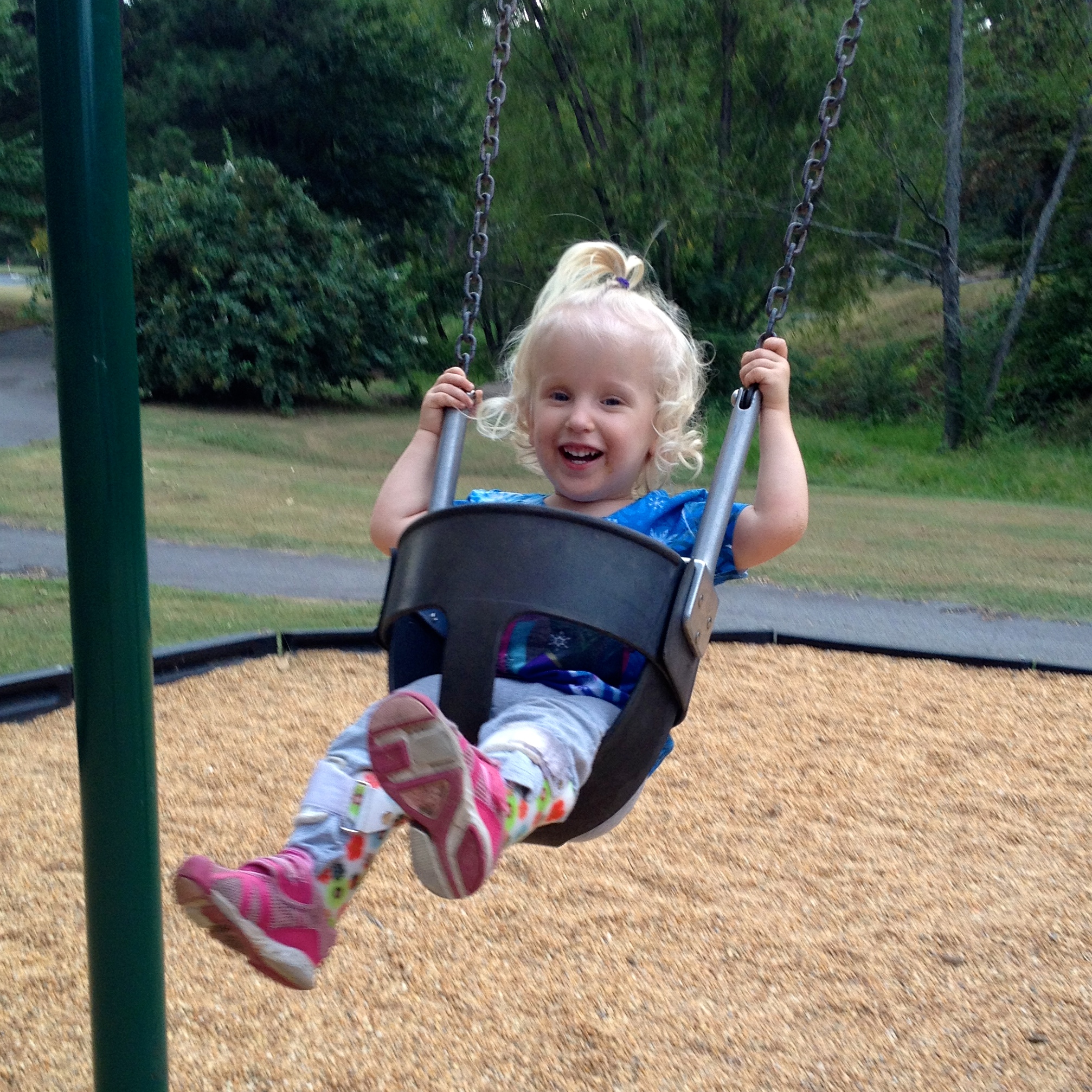
We’re sitting on the couch. Claire reaches up her dimpled hand and touches the knot just behind her right ear, mostly hidden in her loopy white blond curls. “I have an ouchy.” “Oh baby,” I say, “that’s not an ouchy, that’s your shunt! You have that because you have Spina Bifida. Your shunt helps your head feel better.” “Oh,” she says, “I have a buckle on my head.” Continue reading “coming into awareness”
#spinabifida mom tip: a small shopping cart makes an excellent mobility tool at an outdoor Easter egg hunt.
If you read my Twitter bio, you’ll notice that among the facts about myself I chose to include in my scant 140 character allowance, I use the phrase #spinabifida mom.
This means my feathers were somewhat ruffled last night when someone I follow (and like!), whose baby has recently undergone surgery, expressed bewilderment that some moms choose to identify themselves through their children’s illnesses. For one thing, my daughter’s disability is not an illness. It’s not something that we can treat and eventually put behind us. It’s part of who she is and has been since long before she was born. It has shaped our lives in many ways up to this point, and it will be a defining (note I said “a” and not “the”) factor in the rest of our lives. Spina Bifida will mean more surgeries. It will mean more therapies. It will mean doing many day-to-day life processes differently. It will mean concerns about the accessibility of public places and the adaptability of certain activities. It will mean advocacy and activism and acceptance. It’s just a fact that it’s a huge part of Claire’s life, and, because we are her parents, ours. Continue reading “why I call myself a #spinabifida mom”
Having just spent my morning getting myself and the girls ready to go to Spina Bifida Clinic, three hours and change trapped with two two-year-olds in one exam room, and having gotten them home without car napping and successfully into and asleep in their beds, I pondered a daytime adult beverage. Instead, I wrote a blog post. Continue reading “A Claire Update”
My kids are only two, so I’m still not fully in the loop of kid-culture. Frozen largely stayed off my radar during its run in theaters, because I am NOT crazy enough to take these two to a movie in a theater yet, and I didn’t even see trailers because we don’t have cable and they don’t show ads for movies on Hulu very often. I’d see posts in my social media feeds from moms of older kids complaining about watching it for the umpteenth time, or having the songs stuck in their heads, and I even saw a few videos shared that related to the film, like those self-declared good-looking parents lipsynching. (Tip: unless you’re Derek Zoolander, never talk about how good-looking you are.) Continue reading “watching Frozen with my daughters: disability as superpower and the power of sister-love”
My girls rocking their 2012 London Games onesies nearly two years ago.
I am unabashedly obsessed with the Olympics. Winter or Summer, it doesn’t matter. I love watching people achieve their dreams, compete for their countries, and doing their parents, always featured in NBC’s heart-wrenching human interest stories, proud. The summer after the girls were born, pinned to a couch under sleeping or eating babies, I watched a lot of the London Summer Games. This year, my only couch time is after those babies are in bed, but I’ve been watching quite a bit of the evening coverage as well. (If you’re also into watching the Olympics, follow me on twitter and join in on the live tweet action after 7 pm– just make sure to use a hashtag so your friends who are less obsessed can filter your Olympic tweets from their streams.)
One thing that stands out about the Olympics are the ads. Pretty much every spot you see that isn’t for a car or truck features an Olympian of some kind. Proctor and Gamble have been running a series of ads called “Because of Mom” in which athletes thank their mothers for helping them achieve their Olympic dreams. I have no real beef with people celebrating their mothers or motherhood. Motherhood is great! It’s just that…you bet your sweet bippy that if my girls ever make it to the Olympics (I’m thinking 2 man bobsled, maybe?), they’ll have their dad to thank as much as their mom. Because they are blessed to have an amazing dad, and I am blessed to have an amazing coparent. My husband and I are both blessed with amazing and involved dads, too.
I mean, it’s really no wonder I grew up to marry a man who turns out to be an amazing dad, because involved parenting is just what I expected based on what I grew up with. My dad, a doctor, but also a scientist, came into my science classes with a little red wagon full of props and gave talks worthy of Bill Nye. He worked odd shifts, so he drove a lot of carpools. He created elaborate treasure hunts for us with riddle clues. He got me into nerdy stuff like Star Trek and the Civilization computer games. He got me through high school math and science, both of which were hard for me, with intense, one-on-one homework help, complete with antics like “the ribosome dance,” which I will never forget, ever.
I’m willing to bet at least a few Olympians had dads like my dad and my husband. Unfortunately, P&G isn’t talking about them. I say unfortunately, because just as I mentioned in my “inspiration” post, kids need to see normal, everyday people as role models– how can people who may not have amazing dads in their life grow up to be or expect to co-parent with amazing dads if we don’t see dads being normal and amazing in our lives?
I do want to shout out a company getting it right. I loved this Frosted Flakes ad featuring one of our women ski jumpers (first year in the Olympics for their sport after decades of fighting for equality!), Sarah Hendrickson and her dad: Sarah clearly has a dad like mine. They even have the same taste in names for their daughters!
Meanwhile, if you go looking for a P&G ad featuring a dad, you’ll find this, from Tide:
DADMOM? REALLY? A dad who stays home with the kids and takes care of the house isn’t Mr. Mom. He’s not a dadmom. He’s just a dad. He’s parenting. He’s caretaking. He’s not stepping outside his gender or being anything less than a man– a man who has and cares for a family. It’s like when I hear people say a dad is babysitting his own children. Nope. That’s parenting, folks. People of all gender identities and expressions can do it.
P&G claims to be a “proud sponsor of moms.” Well, sponsors usually pay people, rather than expecting to be paid, P&G. And I’m not buying the gendered view of parenthood that you’re selling.
I also have similar issues with their vision of disability:
While on the one hand, I love that they’re running ads featuring athletes with disabilities that showcase them as athletes, using the same visual style and soundtrack as the able-bodied athletes, they lost me at the final tagline. I’m not one of the world’s toughest moms just because my daughter has a disability. As I said on twitter when I first saw the ad, I think most people are as tough as their circumstances require them to be. We all rise to the occasion. If you “don’t know how I do it,” it’s just because it hasn’t been required of you (yet). Just as it doesn’t take a special person to love someone with special needs (because they are no more inherently easy or difficult to love than any other person), it doesn’t take a tough parent to parent a child with a disability. Because you just parent them, because they’re your child.
If someday Claire is a Paralympian, she’ll be thanking both of her parents. And she certainly won’t be calling us any tougher than anyone else.
Although I finally closed comments on my “Not a Hero” post, likes and feedback continue to roll in. Nothing I’ve ever written has generated such a response before, and I am so thrilled and humbled. Perhaps most of all, the feedback that has meant the most to me is that of adults with disabilities, who without exception, have told me basically, right on, I’m not a hero, just a person living my life.
And while it may sound counter to my “not a hero” message, I find them, the people who have left these comments and messages, incredibly encouraging. Not in a patronizing way, but in a window to the possible future for my daughter sort of way. Just as I want my girls to know and see strong, smart women out in the world as encouragement, as windows to their possible futures, I want Claire to see normal, everyday people with disabilities to let her know that there are all sorts of possibilities for her life. Possibilities that include meaningful work, deep relationships, fun hobbies, athletics and exercise, and anything else she may so desire.
When we got our diagnosis, I knew nothing about spina bifida, and our doctors seemed to know very little about what we could expect for our daughter, because spina bifida includes such a range of disability and experience. This whole journey has been characterized by a deep hunger for knowledge on my part. I remember finding the blogs of parents raising kids with SB, and just putting a face, a beautiful KID face, to what was at first a scary and mysterious disease gave me so much peace. Now, as she grows, I find myself still hungry, not so much for facts, but for glimpses of what her life might be. And the more I read and hear from adults with disabilities, the more I realize that my hopes for her as a person with a disability aren’t that different for my hopes for my girls as future-women. I want freedom, autonomy, and bravery for them both. I want them both to have the courage to stand up to both sexist and ableist oppression that they may encounter in their lives.
It’s why I related so well to this post, which I found via Rachel Held Evans. The writer talks about seeing adults with disabilities in a new way as the parent of a child with a disability, and finding them inspiring, and in the piece she tries to draw a distinction between that and the patronizing, limiting “inspiration” I addressed in the “Not a Hero” post. I think, as Ellen seems to be saying in her post as well, that the difference is largely a problem with the word “inspiration.” We rightly bristle at the idea that our kids are “inspiring” just for navigating the world in the only bodies they have ever known– that’s no more noble than any of us learning to navigate the world in the only bodies we’ve ever had. But we also, like any other parent, are searching for role models for our kids. Not role models as in Batman or even Olympians, but actual people, whose lives look like their lives. We face a future full of unknowns, and we just want to see that there are lots of possible futures, and they’re good. I’ve heard moms of boys talk about finding good male role models for their sons. As a mom to girls, I feel no qualms talking about my desire for good female role models. And as the mom to a daughter with a disability, I look for the same.
I’m thankful my post has connected me to so many perspectives from so many voices I wasn’t reading before. I’m just starting out, and I have much to learn in order to best raise my daughters to be women in the world.
When we first began our journey with spina bifida, I didn’t know anyone with SB or anyone whose kid had it. One of the best things that has happened over the last two years is I have found other people who are going through the same thing, bloggers whose kids have SB, and message boards full of parents whose kids have SB. This community has been helpful and informative, but most of all, it has let us know that we’re not alone. Still, some things have become apparent as we’ve delved more into the special needs community that make me uncomfortable, and one of them really crystalized for me yesterday when chatting with a friend who also has a toddler with SB. Basically, as my friend and I agreed, it’s this:
The tendency of parents of kids with special needs and disabilities to say their kids are “heroes” makes me deeply uncomfortable.
On the one hand, it makes perfect sense. We see our kids go through so much more than most typical children deal with– surgeries, therapies, challenges, and pain, and we see our kids thrive and survive in spite of it all. We’re impressed by their resilience, and we want to express that. Also, in a world that marginalizes and devalues many people with physical and cognitive disabilities, we want to affirm the worth and value of our kids. I see no malice there.
But what concerns me is that calling our kids heroes is just another form of dehumanization and marginalization. Our kids are KIDS, first and foremost. They’re people, human beings, whose value lies simply in the fact of their personhood, not in milestones or hurdles overcome. When we put them on pedestals and call them heroes, we make them something other than human beings. And we give them a standard that, at times, may be hard for them to live up to. They might not always feel like being heroic. Sometimes they might just want to be kids, people, frustrated and fed up and overtired and hungry and in a bad mood and all the other less-heroic stuff we feel from time to time.
Having twins, one of whom has SB and one who doesn’t makes this really apparent to me. Both of my kids are just people, existing in the bodies they were given, facing any challenges that come their way. To borrow a phrase that I learned from Sesame Street*: having spina bifida is normal and natural and fine for my daughter. She’s not heroic for existing in her body any more than anyone else is, because she has always been this way. Calling her a hero is just another side of the coin from feeling sorry for her, and I don’t want people to do either. I want her to have the beautiful freedom to be a complex, complicated human being who both overcomes challenges and makes mistakes, who can be joyful and angry and every other emotion there is, with no pressure to be anyone but herself. She’s no hero, she’s something much more magical and mundane: a little girl, full of untold potential, just like her sister.
*We recently watched an old episode of Sesame Street which featured a young man named Rocco who happened to be blind. He is introduced to Elmo, and when Elmo finds out Rocco is blind, he says “I’m sorry.” Rocco tells Elmo he doesn’t have to be sorry, because being blind is normal and fine for him, just like being able to see is normal and fine for Elmo. I really loved it. Plus, Rocco is a great singer.
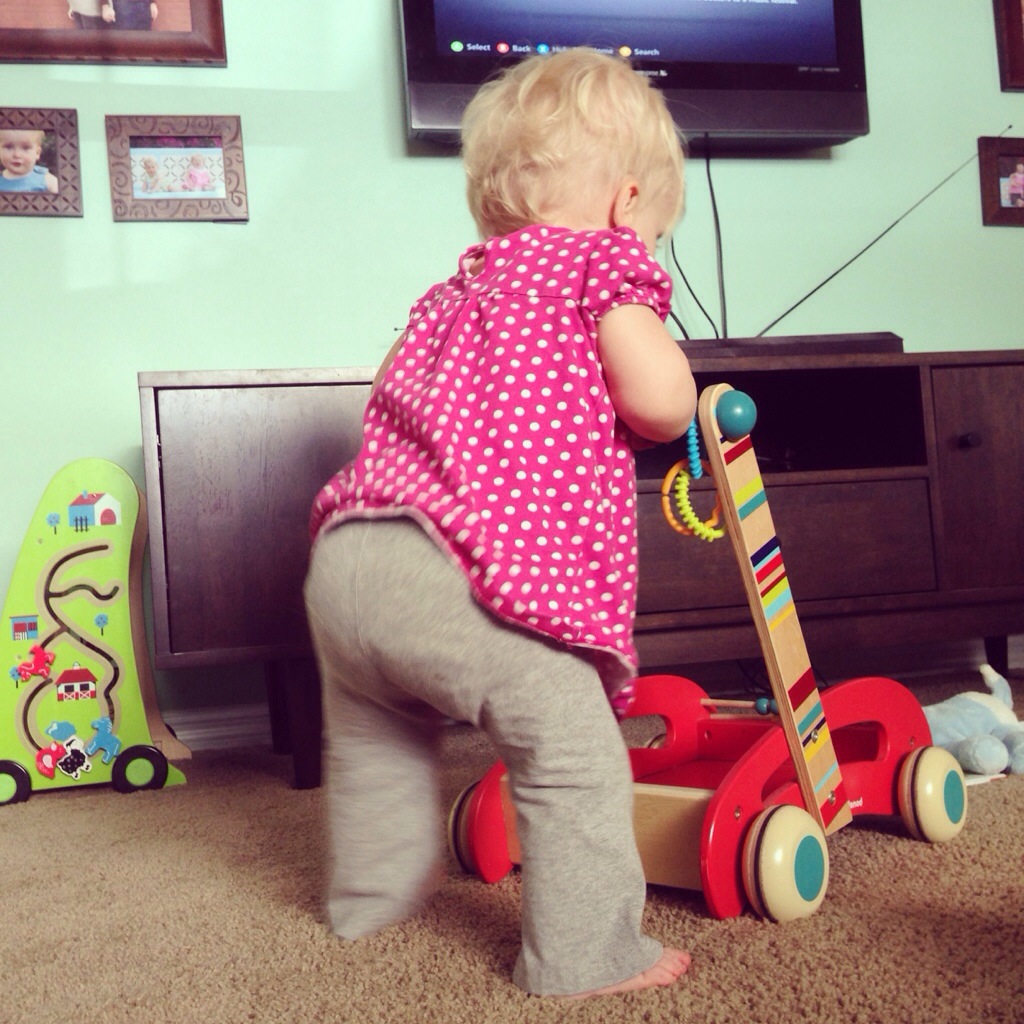
By now, you have probably seen me shouting this from various social media rooftops, but my Claire Bear took her first independent steps with her PT today:
This is HUGE. She has been so motivated and has worked so hard to get to this point. All day at home, she grabs us by the hands and says, “Wanna WAH!” I think she knew she was super close, and now she’s finally done it. And she couldn’t have picked a better day– this morning I logged into Facebook and saw the Spina Bifida Association going on about birth defect prevention awareness and how it’s folic acid week. Stuff like that always makes me a little ragey, because I wasn’t folic acid deficient. My kid just got spina bifida anyway. It happens. It’s not my fault, and it’s not anybody’s fault. By all means, if you are a woman of childbearing age, take your folic acid, to prevent all sorts of possible problems in the event that you should become pregnant. But please don’t labor under the misapprehension that all neural tube defects are preventable– I’ve even heard of misinformed DOCTORS saying things like, spina bifida is 100% preventable, and blaming mothers for their kids’ disabilities. (Best estimates I’ve read say that folic acid could prevent about 60% of cases of spina bifida. It would still exist even if everyone had plenty of FA.)
But today, today there is no raging about folic acid. Today there is just rejoicing and celebrating that my beautiful girl has finally achieved something she has been working SO HARD to achieve. She’s stubborn and tenacious and hopeful, and I truly believe nothing can hold her back.
October is Spina Bifida Awareness Month, not that you’d know it, as apparently October is the most crowded of all awareness months, most famously shared with Breast Cancer Awareness, but also Down Syndrome, Autism, Domestic Violence, and Bullying Prevention. To make matters worse, the Spina Bifida Awareness symbol is apparently a yellow ribbon, which everyone else knows is the symbol for supporting the troops, spotted on many a bumper sticker. Basically, I think we need a new month and a new symbol, but they didn’t ask me.
Though “they didn’t ask me” could be the whole theme of my all-too-keen awareness of Spina Bifida in general. They didn’t ask me, and they didn’t ask Claire, if we wanted SB in our lives. They didn’t ask the other 1 in 800 babies born with myelomeningocele SB (the most severe form, what Claire has) either.
I feel like this week has been an effort on our doctors’ part to make sure we’re REALLY REALLY AWARE of this whole spina bifida thing. Last week we made 3 separate trips to the children’s hospital for various tests, and this week we made two trips to talk to the doctors about the results of those tests. And the news, while not surprising, is bumming me out a little bit. In addition to mobility limitations, bladder and bowel issues are very common for people with SB, and though we had been hoping to continue avoiding it, in order to prevent recurrent UTIs and prevent damage to Claire’s kidneys, our urologist says it’s time to start catheterizing to get her bladder fully emptied. This means cathing her every 4 hours. She’ll also now have to take a daily medicine to prevent bladder contractions. A side effect of this medicine will likely be constipation. I know (really, I do) that ultimately this is the best course of action and is what will help her maintain continence as she grows, but for some reason in my head, having to take this step, having to cath, seems like it makes her more disabled, more different, and I just don’t like it.
WHAT? You’re gonna make me go to the doctor 5 times within 7 days?!
We also got x-rays and saw the orthopedist, and it looks like at some point, Claire is going to need a surgery on her left leg to fix the way her foot turns severely inward. For the short term, she’s getting a special brace to wear at night, but in 6 months to a year, we’re looking at another surgery. Again, I’m all for whatever we need to do to give her the most mobility and independence, but hearing that my baby needs another surgery is hard.
And yet, we have so much good news too. She got an MRI, and we saw our neurosurgeon, and her shunt is working beautifully. I really credit it with the way her mobility is exploding, and our surgeon agrees. We’ve officially been cleared by neurosurgery, and, barring any shunt malfunction or infection, won’t be seeing her for a YEAR! We’re definitely celebrating that milestone.
So, what would I like you to be aware of this month for Spina Bifida Awareness Month? Yes, I want you to know that sometimes it’s hard. Sometimes there’s more surgery and more hassle and more hard work than we’d like. Sometimes I get angry or sad. But mostly I don’t. Mostly, I focus on the fact that both of our girls are beautiful, funny, joyful, smart, silly, typical toddlers. Mostly, I think that’s what I want you to be aware of– Spina Bifida has challenges, but it’s just another way of being a human in the world.





 erniebufflo's south & west kitchen