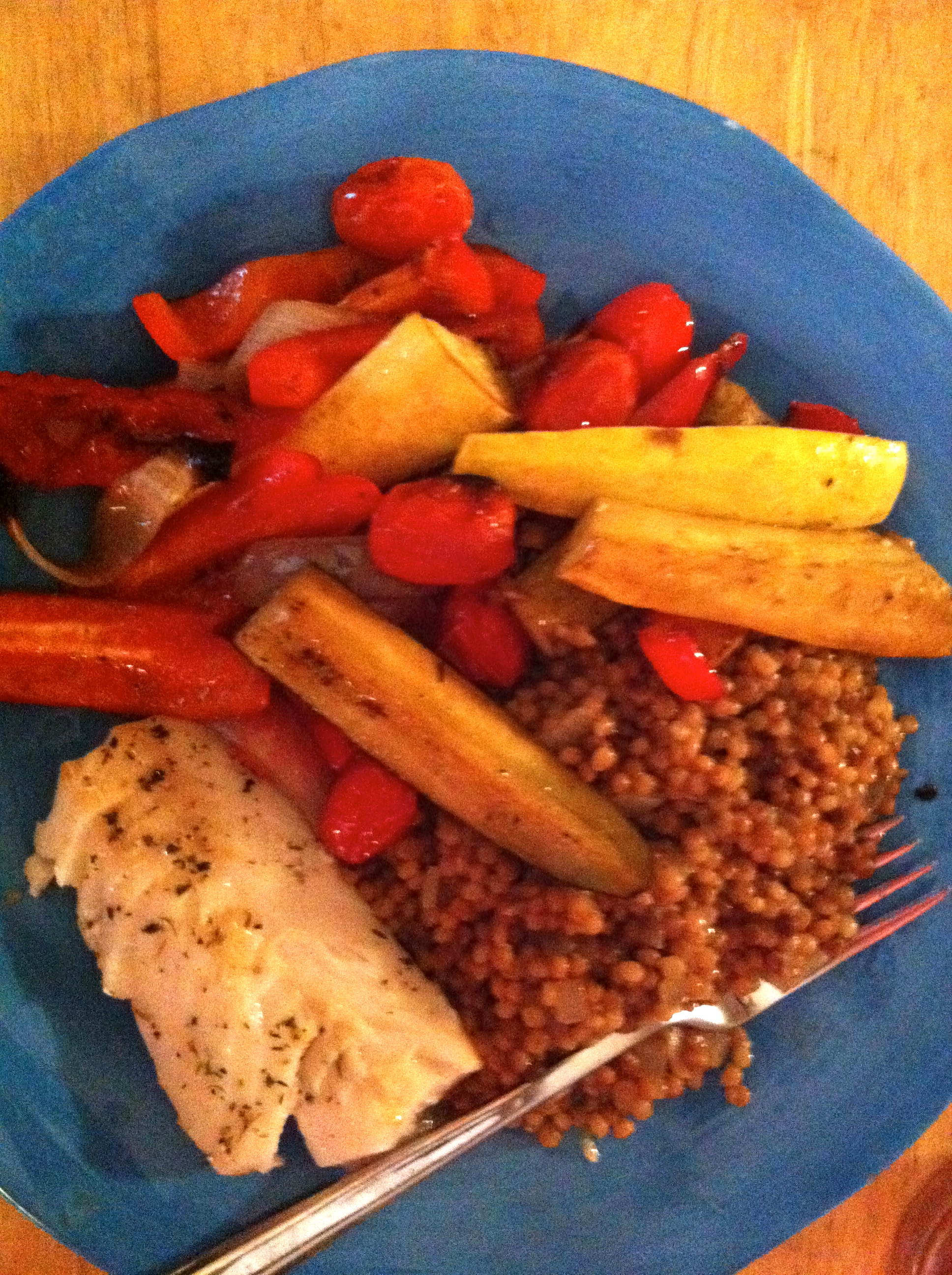
the view from my table

So, food blogging. It’s something I have definitely fallen down on, what with being busy with learning about literature and generally falling out of regular blogging in the post-a-day way I used to do. But, I’m still a total foodie, and have been meaning to get back into geeking out about food.

Add to that, I was recently chatting with a friend about our less-meatarian diet, and she was asking me questions about what our meals actually look like. It’s definitely hard, when first transitioning to a less-meat diet, to figure out what to put on a plate that isn’t a meat and two sides. Mark Bittman addresses this in his book (an AMAZING resource) How to Cook Everything Vegetarian:

Even those people who do cook at home reckon that the easiest way to anchor a meal is to throw a steak or a chicken breast on the grill or under the broiler and scatter a few nominal vegetables around it…But a vegetarian meal is more commonly a table with a few dishes on it, all of them of equal importance…The grain is not less valuable than the cooked vegetable, the salad, or the bread: they’re all there to compliment one another. Pickles you made yourself, a nice piece of cheese, or a bowl of nuts–all are valid courses in the vegetarian meal.

Now, Bittman is certainly not a vegan (note the cheese reference), and neither am I. I choose to eat much less meat than the average American for environmental, humanitarian, and health reasons. I try to follow the dictates of Michael Pollan’s famous maxim: Eat food, not too much, mostly plants. I try to eat food, by which he means whole ingredients, rather than food products or processed foods. And I try to eat more plant-based foods. But I still eat fish, eggs, and cheese, and the occasional ethically-raised meat when I can afford it.

Anyway, I figured that a weekly roundup of what we actually eat might help friends looking to transition to a less-meat diet get some ideas about what less-meat meals actually look like. These posts will be characterized by most-likely iPhone photography of our meals, which, I confess, more often than not are eaten on TV trays in our living room while we watch something from our DVR. I’ll share links to recipes when I can, or share which cookbooks the recipes came from. My two most frequently used cookbooks are both by Bittman– the aforementioned How to Cook Everything Vegetarian, and The Food Matters Cookbook.

So, what did our meals this week look like?
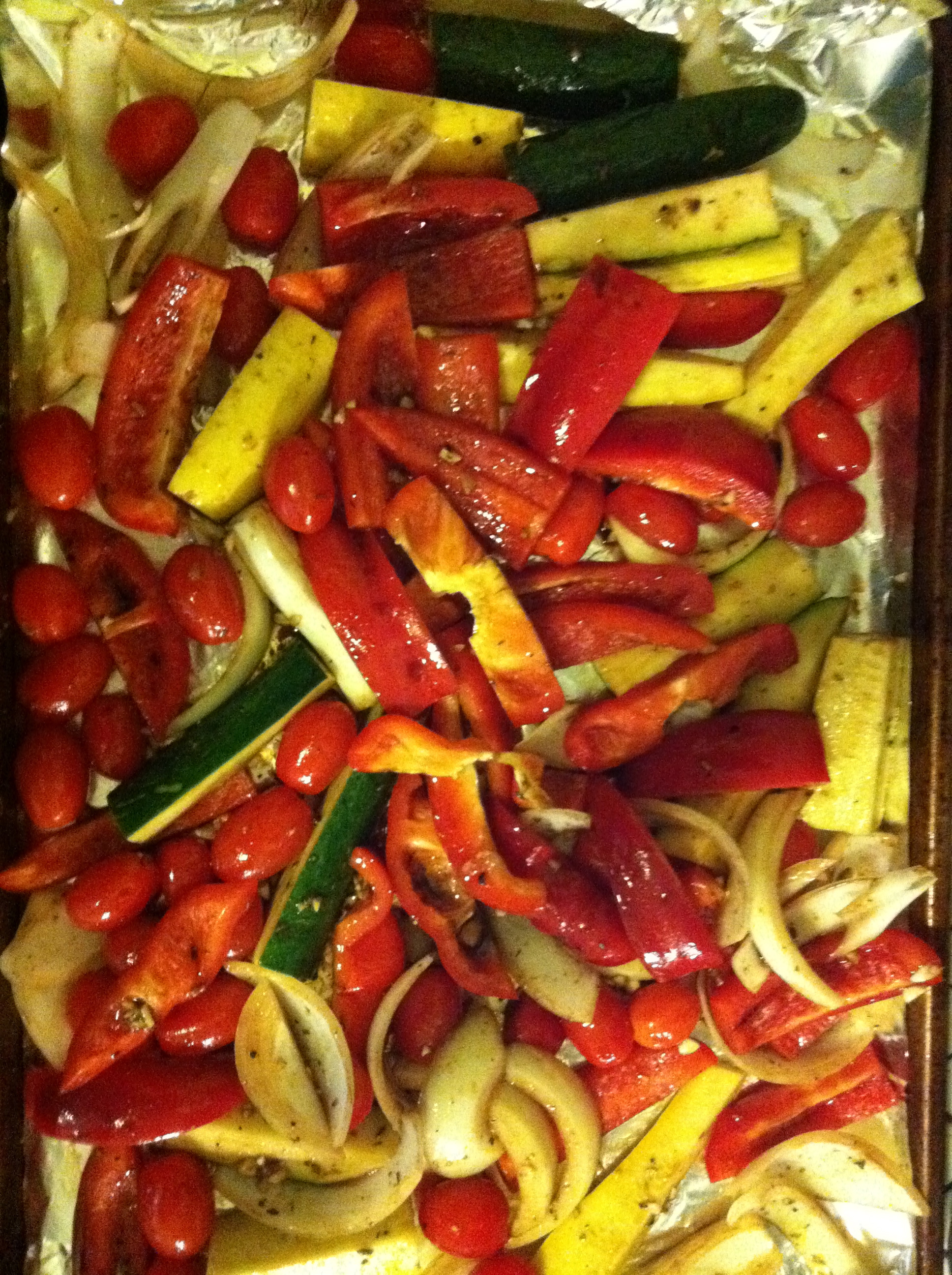
This meal was definitely the most veggie-licious of our week. I tossed a bunch of sliced veggies (red bell pepper, zucchini, squash, onion, grape tomatoes) with balsamic vinegar, olive oil, garlic, and some Herbes de Provence. I broiled them for about 15 minutes while I made some pearl couscous and cooked a couple of pieces of fish in a skillet. Such a tasty and colorful meal. The fish was really not even necessary. Might have poached an egg and served it on top or just tossed in some chickpeas for a fish-free version.

This is a common meal for us. Cuban-style black beans (I skip the radishes) over coconut rice (the idea for the rice came from this recipe). Almost always eaten with a Cuba Libre (rum and Coke with a lime).


Do those veggies look familiar? They’re leftover from meal #1. I cut them into bite sized pieces, sauteed them til warm, and then added some eggs and gruyere cheese to the mix, for a sort of veggie scramble. I do some variation of this a lot when I have leftover veggies that need to be used up.

Our other meals this week: cheese dip and margaritas and guacamole at a fave Mexican restaurant. Cheese dip and salsa another night too. Chicken and veggie pizza from another fave place. And Mexican night at our church. Might be avoiding anything with a Mexican flavor for this next week!

skipping seasons

It's porch swing weather. Fetch me a julep.

They say that if you don’t like the weather in Arkansas, wait 5 minutes and it will change. I’m reasonably sure they say this other places too, but we like to pretend we have a lock on weirdly oscillating weather patterns. The reality check, as my mountain man husband likes to remind me, is that places like Denver can have record-setting 84 degree days followed by whiteout snowstorms that cancel Rockies baseball games (true story).

These days it seems Arkansas has decided to skip straight to summer. In the evenings, you can already hear the chorus of cicadas buzzing in the trees (my husband calls them “skeedeedees,” an onomatopoeic word he coined to capture the way they sound, and I love that coinage). As I stood out in the street talking to a neighbor the other night, a mosquito bit my leg. ALREADY. And today, when I was driving down the road, I could see those hazy mirages that form on exceptionally hot asphalt. I glanced at my thermometer and it was 90 degrees.

And while I will absolutely complain about the heat and the humidity and the havoc both wreak on my hair, the truth is, I love me some Southern summer. My Colorado in-laws may melt in this kind of weather, but I’m like my region’s native flowers: gardenias, magnolias, and jasmine. Sure, I may not smell as nice as they do when it’s sweltering out, but this is my kind of climate. If you want to see me wilt, send me where it’s cold. If you want to see me thrive, plant me in some Southern soil. Just look around– Southern ladies are blooming all over in brightly colored skirts and sundresses.


Side note: Yes, I know, I sort of dropped off in the middle of the Beatitudes series. It will be back this week, I promise.

Beatitudes Part III: Hunger, Thirst, Righteousness, and Mercy

This is part III of a series of posts on the Beatitudes. Check out parts I and II if you missed them.

We’ve now reached “Blessed are those who hunger and thirst for righteousness, for they will be filled.” I have traditionally heard this preached as “God loves the goody two shoes,” as if it says “Blessed are those who want to be good little Christians all of the time.” The problem with this reading is that this is not a light yoke or an easy burden. Those who want to be good little Jews all the time would be the Pharisees. This is not our Jesus. He didn’t go around recruiting the goody-two-shoes. He picked the folks who don’t have it all together. It would not be good news. So there must be another way to read this.

To me, righteousness is when things go the way God planned and designed them to. When we exist in right relationship to God, to each other, and to all of creation. Some folks call this right relationship God’s “shalom” which means peace.

To hunger and thirst are downright visceral feelings. To me, to hunger and thirst for righteousness is like that sick at your stomach feeling you get when you encounter something that is just so not right with the world. Something that is so clearly not God’s plan for the world. To experience the tension between what God created the world to be, and what it is like right now. But in that tension, in that lack, in that fallenness, in our frustration, and heartbreak, and longing for things to be made right, God is with us. God’s sick at God’s stomach too. God’s heart is broken too. God longs for things to be made right too.

This verse in some ways reminded me of the Japanese earthquake. Though some like John Piper might claim that God caused the earthquakes in order to teach us a lesson or send us a message, ours is a God who hungers and thirsts for a world in which these things don’t happen. Not a God who causes these things to happen. God is with us when horrible things about the world break our hearts. Not when we get them all fixed, but when we struggle, when we wonder, when we question, when we feel the disconnect between the way things are and the way they should be. This is great news, because it’s easy for bleeding hearts like me to get overwhelmed and feel hopeless and powerless because we can’t fix it all or even do something about it all. But God is with us in that place.

God can handle it when we feel like Habakkuk (Ch. 1): “How long, LORD, must I call for help, but you do not listen? Or cry out to you, ‘Violence!’ but you do not save? Why do you make me look at injustice? Why do you tolerate wrongdoing? Destruction and violence are before me; there is strife, and conflict abounds.” God can handle our anger, can handle our sorrow, can handle our concern. In fact, God is with us in that feeling. To me, that is good news.

God is also with us when we move from tension, anger, and sorrow into action. “Blessed are the merciful, for they will be shown mercy.” To me, this is where the Beatitudes begin to move from conditions (mourning, poverty of spirit, hunger and thirst) to action. To be merciful is to have compassion for another and to be moved to action to change that situation or express love and care. I don’t have much to say about this particular Beatitude, because it seems fairly straightforward, but I will point out that it seems rather interesting that Jesus seems to be advocating a salvation based on works if we look at this line alone. Do mercy, get mercy.

Beatitudes Part II: Blessed are the meek

A very "meek" looking Jesus preaches the Sermon on the Mount.

In case you missed it, I’m doing a blog series this week on the Beatitudes, based on a talk I gave at my church on Sunday. If you missed Part I, check it out, because it’s crucial to understanding how I’m going to look at the rest of this text.

I’m skipping “Blessed are those who mourn, for they will be comforted” because Ryan covered that in a different talk.

So, moving on to “Blessed are the meek, for they will inherit the earth.” This one immediately made me wonder if my being asked to cover these verses was some kind of joke. I am so NOT meek, as it is usually defined, and everyone who has known me for even 5 minutes can attest. But, I was asked to speak on this text, and all I can think is, well, I guess they probably realized I wasn’t just going to say meek is being shy and pitiful and unobtrusive and that Jesus is telling us to be this way.

So I immediately set out to look for other places where the Bible uses the word “meek.” One clue as to what “meek” means can be found in Numbers 12:3, talking about Moses. My TNIV says “Now moses was a very humble man, more humble than anyone else on the face of the earth.” Many other translations use “meek” here instead of humble. So perhaps meek can be understood as humble. I mean, Moses stood up to Pharaoh and liberated the Israelites. Obviously he wasn’t “meek and mild” as we usually think of it. But he was humble.

Another clue can be found in who Jesus is talking to. At this time, the world had been conquered by Rome. THEY had carved up the earth. They seemed to be the ones who inherited the earth– the ones with big swords and military might. And here Jesus is saying the MEEK are the ones who are blessed. The down and out. The oppressed. The have-nots. And while some might say, well, the powerful can have the earth, because we’ll have heaven, Jesus is saying, No. The EARTH. It goes to these folks. Because ooh, baby, heaven is a place on earth (more on that in a second). And, as with “blessed are the poor in spirit,” this blessing tells us more about the one doing the blessing than the one receiving it. And what that tells us is: God is not on the side of the powerful. God is not on the side of the oppressor. God is not on the side of the one with the giant army. God is on the side of the weak, the powerless, the oppressed, the slave, the orphan, the widow, the poor, the hungry, and the downtrodden.

Now that we’ve sort of clarified that “meek” can perhaps better be understood as “humble,” and that we’ve also connected it to the fact that he was speaking to a group of people whose land was occupied by a great military empire that already seemed to have inherited the earth, we can look at the fact that by even using the phrase “inherit the earth,” Jesus is referencing a long tradition, a concept with a context.

Giving Abraham and his descendents a land to inherit, possess, and own, was part of God’s covenant with Abraham. What at first was meant as possessing the land of Israel becomes expanded and enlarged through Jesus to mean possessing the kingdom of heaven, which will literally be on the earth. You see this in prophecy in other books of the Old Testament:

Isaiah 57:13 “Whoever takes refuge in me will inherit the land and possess my holy mountain.”

Isaiah 60:21 “Then will all your people be righteous and they will possess the land forever.”

Psalm 25:8 “Good and upright is the Lord; therefore he instructs sinners in his ways. He guides the humble in what is right and teaches them his way. All the ways of the Lord are loving and faithful toward those who keep the demands of his covenant. For the sake of your name, Lord, forgive my iniquity, though it is great. Who, then, are those who fear the Lord? He will instruct them in the ways they should choose. They will spend their days in prosperity, and their descendants will inherit the land.”

And Psalm 37 is especially full of references to inheriting the earth:

“For those who do evil will be destroyed, but those who hope in the Lord will inherit the land.” (v. 9)

“But the meek will inherit the land and enjoy peace and prosperity” (v. 11)

“The blameless will spend their days under the LORD’s care, and their inheritance will endure forever.” (v. 18)

“Turn from evil and do good; then you will dwell in the land forever.” (v. 27)

“The righteous will inherit the land and dwell in it forever.” (v. 29)

Then there’s Psalm 69:35: “God will save Zion and rebuild the cities of Judah. Then people will settle there and possess it; the children of his servants will inherit it, and those who love his name will dwell there.”

There are other references in Ezekiel 33 and Romans 4:13, but I think you get the point. Inheriting the earth is a big part of God’s covenant with God’s people in the Old Testament, a big part of the Old Testament prophecy about what God would later do, and now, in the Beatitudes, reappears as part of Jesus’ promise/announcement to the people who will be part of God’s kingdom on earth.

“Inheriting the earth” is about a future time and place in which heaven and earth, the place of God and the place of people, become one. A place in which everything works according to the Way of Christ and everything broken is made whole, and things are as God always intended them to be. The Bible calls this the New Jerusalem. It is not a place we fly away to when we die, but a reality that we can participate in during this life, on this earth. It is a place that we can live in now, and that we can participate in bringing about. Greed, exploitation of the environment, violence, oppression, betrayal will not be part of this New Jerusalem. This is why Jesus refers to Psalm 27. Some things will wither away. Others will survive. When we focus on the things that survive, things characterized first and foremost by love, we participate in eternal life and the Kingdom of Heaven in the here and now, a way of living that will last forever.

a new series: The Beatitudes

Me giving my Beatitudes talk. No, I have no idea what is up with the claw hand.

My church, Eikon, is in the middle of a series on Jesus’ Sermon on the Mount (starts in Matthew 5). We just got started, so it’s a great time to join us if you’re interested. This week, I was asked to speak on the Beatitudes, and I figured I’d turn my talk into a series of blog posts to share with folks who didn’t/couldn’t attend (or just folks who didn’t catch a word I said because I’m such a fast talker). I will say that I am not a pastor or theologian. I’m just an English literature scholar/grad student who likes Jesus.

Anyway, consider this Part I on the Beatitudes!

To start, I think the way I’ve often heard the Beatitudes preached makes them out to be some sort of checklist of things we must do to be blessed by God. I’m not sure that a checklist of to-dos in order to earn God’s favor would have been considered radical, crazy good news to a group of Jews and Gentiles, so I’m pretty sure this is not how Jesus intended us to take this text. Instead, I think the Beatitudes are a sort of radical manifesto about the nature of the kingdom of God.

This reading is greatly informed by the very first Beatitude: Blessed are the poor in spirit, for theirs is the kingdom of heaven. Right away, you can’t read this as some sort of “to-do.” Why would you want to be poor in spirit? To be poor in spirit is to not get it, to doubt, to question, to feel far from God, to be, as The Message puts it “at the end of your rope.” This is not a desirable condition. Instead, this is a statement less about the one who is poor in spirit, and more a statement about the one handing out the blessing: God. It’s not a statement about earning or deserving God’s blessing, but a statement about a God of extravagant love who pours out blessings on even, and perhaps especially, those who do not deserve it. There is no why to the pouring out of God’s blessing. Ours is a God who likes to bless, choose, and use the people that we think don’t deserve it. This is good news. Our God loves to bless all the people who don’t deserve it, who screw up, who doubt, who don’t believe all the right things, who don’t do all the right things.

In this light, all the rest of these Beatitudes are not about what we must do to earn God’s blessing. The focus is not on the condition of the one being blessed, but on the nature of the one doing the blessing, and, by extension, the nature of the Kingdom of Heaven, which Jesus repeatedly announces is at hand. This might make us look at the rest of the list in a different way, and I’ll be going through all of them step by step, every day this week.

help turn on the TAPs

I was supposed to have this post up hours ago. But, two days ago, I somehow dropped my mug of coffee onto my 4 year old MacBook. It just fell right out of my hands and landed right on the keyboard, coffee seeping everywhere. Jon immediately suspected that I’d done it on purpose, as I’ve been talking about wanting a new laptop for weeks, as the old lapple was getting slower and less reliable, and in one spot was held together by duct tape. Of course, had I tried to sabotage the laptop, I probably wouldn’t have dumped hot coffee on it, and myself, while sitting on our ivory sofa. Thank God for ScotchGuard. Though it had already survived Jon spilling a mojito on it last year, the coffee proved to be too much for the lapple. It turns on and still works, but the keyboard doesn’t. Because I have a million and one things to do for school, freelancing, and am teaching at church on Sunday, we needed a new computer ASAP. Jon’s desktop happened to have died a few weeks ago. So, we went out and bought a 13 inch MacBook Pro at Best Buy.

We are so incredibly privileged. So crazy freaking incredibly privileged.

I can go out and get a new, fancy schmancy laptop, and yet 4,000 kids die every day because they lack access to clean, safe drinking water. That’s just unacceptable. And a major barrier to clean drinking water for people all over the world isn’t a lack of wells, it’s simply broken pumps. And there’s a group of people doing something about it. They’re called The Adventure Project, and they’re raising money to train hand pump well mechanics and to repair broken pumps, to give people life-saving access to safe drinking water. My friend Alex asked me to join the cause and share it with the folks who read this humble blog. It would be amazing if 10 readers could donate $20 to help TAP reach their goal of raising $10,000 in one day, an amount that could provide 300 people with water every month. I’ll be chipping in my $20. Please consider doing the same. Click here to donate.

ashes to ashes

"Penance" via Flickr user Sarah Korf under a Creative Commons License.

Today is Ash Wednesday. And while this may sound morbid, it’s the beginning of one of my favorite parts of the liturgical year. Yes, I grew up Presbyterian. We like words like liturgical.

While many see the church’s liturgical calendar as stale, dry, ritual, I see it as life-affirming rhythm. The church’s acknowledgment that life has its ebbs and flows.  That to everything there is a season.

Lent is a time to “memento mori,” which is Latin for “remember you will die.” We talk about ashes to ashes and wear ashen crosses on our foreheads. For folks like me, prone to existential crises in the middle of the night, it’s a time to acknowledge one of our deepest, darkest fears: death. To name it, to acknowledge it, and to use it as a springboard for celebrating the God who conquers death and wipes away tears. But before we get to that point of celebration, we have to go through the valley of the shadow of death. We have to meditate on our mortality, our brokennes, and even broader, the earth’s mortality and brokenness. We have to find and name the cracks and fissures, so that we can allow those cracks and fissures to be filled with the love of the God of Resurrection and Renewal and Things Made Whole.

This is why we’re supposed to fast and take on new practices in Lent. Not just because we need to get rid of habits and practices that are bad for us, though all the healthy eating people try to do this time of year can never be a bad thing, but because we need to make space for meditation, time with God, time to examine ourselves and our environments. We need to get rid of the things that we use to distract us from our brokenness and mortality. We need to focus on things that do not fade. For this reason, giving something up is not the point of Lent if we’re just giving up something to give it up. The intention is to give up something in order to make space for something else, something that will bring us closer to God, or make us healthier, spiritually or physically.

This year, I am making space to read through the gospels, so that I might come to better know Jesus. I am also making space to take walks with my dogs. I hope to use this time to enjoy God’s creation and spend time with God. I hope this time will be a time of prayer and communion that will bring a bit of peace into my life.

I’d like to close by sharing a piece of T.S. Eliot’s “Ash Wednesday” which is a beautiful meditation for this day (read the whole poem here):

Blessèd sister, holy mother, spirit of the fountain, spirit
of the garden,
Suffer us not to mock ourselves with falsehood
Teach us to care and not to care
Teach us to sit still
Even among these rocks,
Our peace in His will
And even among these rocks
Sister, mother
And spirit of the river, spirit of the sea,
Suffer me not to be separated

And let my cry come unto Thee.

Do you observe Lent? How are you observing it this year?

Update:

I just got my daily Verse/Voice email from Sojourners and was inspired to share this verse:

Is this the kind of fast I have chosen, only a day for people to humble themselves? Is it only for bowing one’s head like a reed and for lying in sackcloth and ashes? Is that what you call a fast, a day acceptable to the LORD? Is this not the kind of fasting I have chosen: to loose the chains of injustice and untie the cords of the yoke, to set the oppressed free and break every yoke? Is it not to share your food with the hungry and to provide the poor wanderer with shelter– when you see the naked, to clothe them, and not to turn away from your own flesh and blood? Then your light will break free like the dawn, and your healing will quickly appear; then your righteousness will go before you, and the glory of the LORD will be your rear guard. Then you will call, and the LORD will answer; you will cry for help, and he will say: Here am I. –Isaiah 58:5-9 (TNIV)”

shoot for the moon

Image via the NASA Goddard Photo and Video Flickr stream under a Creative Commons license.

“Shoot for the moon. Even if you miss, you’ll land among the stars.”

OK, it’s a lame quote. And it doesn’t make any real sense, because the moon is like, millions of miles closer to us than the nearest star, the sun, so, if we shot for the moon and missed we’d be…somewhere between the earth and the moon, and nowhere near a star.

Still, it reminded me of when I literally wanted to shoot for the moon. For a few years of my childhood, I really wanted to be an astronaut. REALLY. I read all kinds of books about space. I even read Stephen Hawking’s A Brief History of Time over and over again, until it stopped feeling like it was melting my brain and I started understanding it (I was in middle school). I begged my parents to let me go to NASA Space Camp.

But it turns out real space camp is friggin’ expensive.

Instead, one summer, I got sent to some science daycamp at a local elementary school. We made space suits out of tinfoil and Saran Wrap and learned about planets and space shuttles.

But we did not get to pull any G forces or play in any simulators. There was no freeze-dried astronaut ice cream. They might have served us TANG.

What a letdown.

Next time my science-loving dad gives me grief about being a grad student in English Literature, I’m going to say: “Maybe if you let me go to real space camp, I’d be an astrophysicist or something right about now.”

you don’t eat someone you’ve shared stories with

This pig looks a lot like Porky, except Porky was much fatter. Image via Flickr user sarniebill1 under a Creative Commons license.

The other day, my friend shared a link to a story about dogs who help children learn to read, just by being passive, non-judgmental, non-correcting, patient listeners. When I saw it, my first thought was, maybe my mom wasn’t so crazy after all.

You see, when I was a kid, I was made to read to a pig.

Somehow, my family wound up with an oversized supposed pot-bellied pig someone had bought as a pet, but which outgrew their expectations. The pig came to live with us because we lived outside the city, on four acres, and already had quite a menagerie, including chickens, ducks, a parrot, sometimes other birds, fish, and dogs. At other points in my childhood, we also had a tarantula named Terry, a wounded woodpecker, and a chicken who thought he was a dog (a story I’ll have to tell another time). The pig was named Porky.

At the time, my mom told me that she was worried Porky was lonely. Pigs are very intelligent creatures, and can get a little crazy when they’re not happy (much like me). So my sister and I were dispatched with books and lawn chairs, told to sit outside Porky’s pen and read him stories. Now I’m beginning to suspect it wasn’t so much for Porky’s benefit, but ours.

Personally, I think this bodes well for my future career as an English professor, because I doubt any of my students could possibly be less engaged than a pig.

Porky later displayed a tendency to escape the pen and run amok in the garden, and was eventually turned into sausage. I refused to eat him, though, on the grounds that you just don’t eat someone you’ve shared stories with. I think it’s a good policy, in general.