talking about gender in a class on women writers? CRAZY!

So, three years after graduating with an undergrad degree in English and political science, I’m finally back in the classroom and loving it.  I fear that my one “non-degree student” class may indeed lead to a degree, though I can’t make any decisions on such things until after December, when I find out where we’ll be spending the next 3 years of our lives.  Anyway, the class is ENGL517: Sex, Power, and Science in 18th Century Women’s Writing.  With Sex and Power in the title, I went into the class pumped to talk about feminist and gender theory, among other things.  I may have even geeked out a bit and pulled out my old Crit Theory text from undergrad to brush up a bit.  What can I say, I’m a nerd!  Anyway, apparently not everyone in my class expected to spend much time talking about gender, sex, and power.

Yesterday at The Pursuit of Harpyness, a blog I frequent, my friend Sarah.of.a.lesser.god did a post called “You Don’t Need to be a Woman to Study (Women’s) History,” about the dearth of men taking women’s studies classes.  On the first day of my class, I noticed that the room was filled with women, with one lone male student.  I hoped that he would be intelligent and willing to contribute a well-reasoned male perspective to our discussions, as I enjoy some good pushback in an academic discussion.  Ok, more accurately, I enjoy a good debate or argument.  However, after the second class, I’m pretty sure my high hopes for this guy were in vain.  Not only is he too timid to really share (which, really, is understandable, it’s intimidating to be the ONLY ONE), but when he does share, he pretty much reveals his ignorance (which, maybe this class is just the eye-opener he needs!). Continue reading “talking about gender in a class on women writers? CRAZY!”

maybe NOT baby…

Image via BL1961s Flickr.
Image via BL1961's Flickr.

So it’s been about a week or two since I wrote my “Maybe Baby” post about starting to think about having kids.  Today I picked up the September issue of Skirt! magazine and read a piece by Valerie Weaver-Zercher, and now I’m pretty sure having kids, while still definitely something that will happen some day, is back in the not SO soon pile.  The piece, called “Mentor or Mom” is about Weaver-Zercher’s experience as a mother of 3 who has a lot of 20 year old college girls in her life.  She sees herself in them, and she seems to have a fantasy about shattering their illusions of what their lives will be.  She imagines:

I pull the college women aside, fix them with a steady gaze and whisper in a conspiratorial voice: I was once like you.  I baked bread in Germany and walked through streams in Nicaragua.  I worked for a magazine and had a company credit card and wrote editorials that shocked people.  I got married to a man willing to clean bathrooms and we lived in a city and walked to market and protested the death penalty.
And then I had a baby. Here I pause, then raise my eyebrows.
And two years later, another. Another significant pause.
And two years later, yet another.
I stop for awhile, until they think I’ve made my point and begin to sidle away. Then I begin again: Each child is like an earthquake that hurls your identity off the shelf, I say. You will spend years picking yourself off the floor, along with everyone else’s socks and Play-Doh. You will no longer know who really wins: the one who goes to the office all day, or the one who stays home with the kids. You will feel guilty about each choice that takes you away from your children, and resentful of each choice that takes you away from your calling. And here I grab them by their scrawny elbows and bring it home: And you will never, ever judge a housewife again!

Yikes! I may not be a college woman, but that’s enough to send me heading for the hills, or at least the birth control pills. But Weaver-Zercher continues:

Young women don’t need phony assurances about how easy it is to be both a mother and an individual, to maintain both a family and a career, to win in both the office and the house. Such platitudes can only lead to disillusionment and anger– unless the next decade brings about sane maternity leaves, affordable childcare, universal health insurance, and family-friendly work environments. (I’m not holding my breath.) Or maybe, if they have children, they and their partners will find better ways to navigate these days of early parenthood– some way to change the world, change gendered patterns and still change diapers. I’ll be the first to cheer them on (provided I’m not too jealous).

On the other hand, maybe some college women will end up like me: bewildered, exhausted, not sure whether they’ve won or not, or whether they even trust the society that’s keeping the score. Indeed, maybe college women need me a little bit like I need them: as a prompt to reexamine how we calibrate wins and losses, and as a reminder that when it comes to motherhood and work, winning and losing are categories that no longer make an iota of sense.

I hope to be one of the ones to change gendered patterns and still change diapers. To read bedtime stories but still find the time to write for myself. But then I read things like this and wonder if I’m not just a hopelessly naive no-longer-in-college woman.

finally, a decent PSA

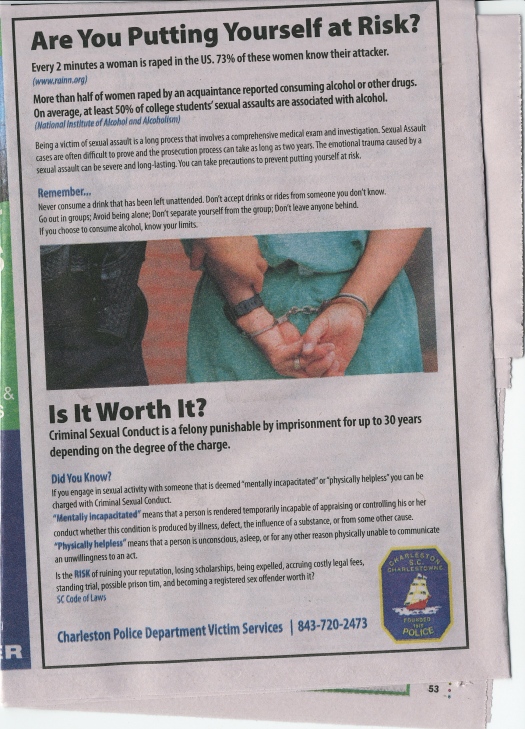
Last night, while waiting for dinner to finish simmering, I flipped open this week’s issue of the Charleston City Paper, our local alt-weekly.  This issue is the annual “welcome back college kids” issue, with advice on cheap eats, good places to go for dates, and ways to spruce up dorm rooms.  Basically all kinds of great Charleston tips that I can appreciate even though I’m not a college student any more, because I’m on a tight budget.  As I turned the page after reading a piece on local thrift stores, I saw this ad:

IMG

I could have applauded.

See, so often PSAs about rape and sexual assault focus on the materials in the first part of the ad, the part that is aimed toward young women.  The part that says, don’t wear that, don’t drink this, don’t go to these places, don’t be out after this hour, don’t hang out with these people.  The feminist in me tends to think that the culture of fear we instill in our young women serves to help keep them under control.  Just thinking about it makes me want to crank up No Doubt’s “Just a Girl” and bop along with my teen idol Gwen. “Don’t you think I know exactly where I stand? This world is forcin’ me to hold your hand!” (Seriously, I wonder how many other 20-30 year olds can point to that song as a major source of their feminist awakening.) Continue reading “finally, a decent PSA”

amen sista!

Via my friend PPG, I read the following, and it is just so, so, so awesome that I am posting it here because I think as many people who can read this should read it.  ESPECIALLY in the wake of the gym shooting in Pennsylvania, which in my mind was absolutely a hate crime against women.  And the following doesn’t just go for men.  I’d say it absolutely goes for women too, and I’ll expound on that after you read THIS, by Kate Harding, whose blog I found recently and have fallen in love with (I censored the profanity because I know some of my readers have issues with it, not because I’m personally opposed to profanity):

You, dear male reader, are totally not one of those men. I know this, and I appreciate it. I really do. But here’s where all this victimy girl s**t concerns you:

  • every time you don’t tell your buddies it’s not okay to talk shit about women, even if it’s kinda funny;
  • every time you roll your eyes and think “PMS!” instead of listening to why a woman’s upset;
  • every time you call Ann Coulter a tranny c*** instead of a halfwit demagogue;
  • every time you say any woman–Coulter, Michelle Malkin, Phyllis Schlafly, Condoleezza Rice, Hillary Clinton, Britney Spears, Paris Hilton, any of us–”deserves whatever she gets” for being so detestable, instead of acknowledging there are things that no human being deserves and only women get;
  • every time you joke about how you’ll never let your daughter out of the house or anywhere near a man, ’cause ha ha, that’ll solve everything;
  • every time you say, “I don’t understand why thousands of women are insisting this is some kind of woman thing”;
  • every time you tell a woman you love she’s being crazy/hysterical/irrational, when you know deep down you haven’t heard a word she’s said in the past 15 minutes, and all you’re really thinking about is how seeing her yell and/or cry is incredibly unsettling to you, and you just want that shit to stop;
  • every time you dismiss a woman as “playing the victim,” even if you’re right about that particular woman…

You are missing an opportunity to help stop the bad guys.

You’re missing an opportunity to stop the real misogynists, the f*****g sickos, the ones who really, truly hate women just for being women. The ones whose ranks you do not belong to and never would. The ones who might hurt women you love in the future, or might have already.

‘Cause the thing is, you and the guys you hang out with may not really mean anything by it when you talk about crazy b*****s and dumb sluts and heh-heh-I’d-hit-that and you just can’t reason with them and you can’t live with ‘em can’t shoot ‘em and she’s obviously only dressed like that because she wants to get laid and if they can’t stand the heat they should get out of the kitchen and if they can’t play by the rules they don’t belong here and if they can’t take a little teasing they should quit and heh heh they’re only good for f*****g and cleaning and they’re not fit to be leaders and they’re too emotional to run a business and they just want to get their hands on our money and if they’d just stop overreacting and telling themselves they’re victims they’d realize they actually have all the power in this society and white men aren’t even allowed to do anything anymore and and and…

I get that you don’t really mean that s**t. I get that you’re just talking out your ass.

But please listen, and please trust me on this one: you have probably, at some point in your life, engaged in that kind of talk with a man who really, truly hates women–to the extent of having beaten and/or raped at least one. And you probably didn’t know which one he was.

And that guy? Thought you were on his side.

Anyway, I really hope you read all that. ALL of it. Even if you’re a woman. Because we all have guy friends, and we’ve all heard them say things like what’s described above, and we’ve probably even giggled along because we want to save face, or look cool, or seem cute.  But when we let stuff like that slide, we’re saying it’s OK.  And it’s NOT OK.  And we have more power than we know over the people in our circles to help them see how even they, charming, wonderful, sensitive they, are contributing to a culture in which a guy might get the idea that it’s OK to walk into a gym and shoot a bunch of women, because he believes it’s women’s fault he hasn’t had a relationship or sex in over a decade, as if that is every man’s right, even if he’s despicable scum.

real women have…

If you are a human, and you have say, eyes, and have encountered either internet, television, magazines, or advertising in any form, you know that society seems to have certain ideas of what is and isn’t beautiful, what is and isn’t feminine.  And for a long time, this has been basically a very narrow concept that (at least as I’ve assimilated it in my little mind) involves whiteness, fairness of hair and eyes, thinness, but with a certain amount of curve in the breasts and hips, and a certain sort of go-along-to-get-along-ness that doesn’t ever make anyone uncomfortable or threatened or challenged.  I could get all feministy and theory-ish on ya, but seriously, I’m sure you know what I’m talking about.

And I totally get that there is a natural desire on the part of anyone who falls outside these narrow strictures to push back, to challenge that, to say, that’s not what a beautiful woman is, THIS is.  But, it seems to me, more often than not, those attempts to break out of the narrow bounds of societally accepted femininity end up creating just another narrow definition.  Now, I’ve been in enough internet arguments on feminist and feminist-leaning websites and even just websites for women to know that most of the time, people don’t really mean what they say so narrowly.  And yet statements like “Real Women Have Curves” make me incredibly sad.  Of course, “Some Real Women Have Curves” doesn’t have the same ring to it, doesn’t fit on a bumper sticker or a tee shirt quite so nicely, and yet, isn’t that what most of us REALLY mean when we say stuff like that? Not to mention, if you look at those Dove models, it’s still obvious that there is an upper limit to what they’re going to put in the ads.  Beth Ditto wasn’t chosen to sell us our thigh-firming cream.  You might not think Beth is pretty (many people do!), but she’s still a REAL woman, just the same.

What set me off TODAY was seeing this on Meghan McCain’s Twitter feed: Picture 1

Isn’t the idea that a “real ass” is “big and juicy” just as reductive as the societal idea that an acceptable ass is the opposite?

I understand that many who know me, who know what I look like, might read a post like this and say THIN PRIVILEGE! And it’s true, my body as it naturally is generally fits into the societal standards of “acceptability.”  I know I come from a place of privilege in that regard.  I know that I do not know what it is like to be looked at and judged in the same way someone who struggles with weight or other physical issues does.  Though I would say that I do know what it is like to not love myself, to hate my own body, to cry because of hurtful things that others say about it, I do not see the world the same way as Meghan McCain, who has been unfairly snarked on by people as high-profile as pundit Laura Ingraham for her weight and appearance, an appearance I think is perfectly lovely.

And yet, really, aren’t we all in this fight together? Don’t these narrow standards hurt all of us?  And when we push back against them and try to overcome them and get rid of them, can’t we do that in a way that doesn’t leave just another group out?

The idea that female bodies are objects for public consumption and judgment is really the problem.  Meghan McCain shouldn’t have to defend her “big and juicy” ass to anyone any more than I should be subject to cat calls while standing at bus stops.  The real slogan should be WHAT MAKES A REAL WOMAN IS NOT FOR YOU TO SAY.

sexism, safety, and the bus

Photo via Googles Life Photo Archive.
Photo via Google's Life Photo Archive.
I ride the bus to work every day, as I’ve mentioned.  And more than any other consideration, where to sit on the bus occupies a lot of my thoughts.  In general, I think of the seats at the front of the bus, the two rows of 6 seats facing each other across the aisle, as a place for older people, or people with strollers and small children to sit, or for people hopping on who plan to hop off in just a few spots.  I also admit that I was raised by people with Good Southern Manners and occasionally have to resist the urge to give side-eye to able-bodied men who sit in these seats, because of some sort of vague “women and children first” idea.  I’m generally able bodied, and generally, I would think someone like me should not sit in these seats unless no other seats were available.

BUT.  That was before my now several experiences of male creepiness on the bus.  Continue reading “sexism, safety, and the bus”

what if “what women want” isn’t what we want?

Much has been said about a recent study (.pdf) that shows that womens’ happiness is actually trending downward,

I think Mrs. Marge Sutton, Ideal Housewife, makes a great illustration for this post.  Via the Google LIFE archive.
I think Mrs. Marge Sutton, Ideal Housewife, makes a great illustration for this post. Via the Google LIFE archive.

rather than upward as time, and presumably society, progresses.  To conservatives, it’s proof that feminism and liberation are contrary to nature and naturally lead to unhappiness.  To progressives, it’s proof that feminism hasn’t gone far enough.  To environmentalists, it’s proof that consumerism just makes us less happy.

I’ve been wondering about a different angle.  I’ve mentioned that we recently got rid of cable, and are now relying on the internet and Netflix (both DVDs via mail and streaming via our Xbox 360) for our televised entertainment.  And while I’m not generally one to blame problems on the ominous “The Media,” I “can’t help but wonder” (to pull a Carrie Bradshaw) if maybe it isn’t all our media connectedness that is making us unhappy.  Continue reading “what if “what women want” isn’t what we want?”