I love Lent. I know that sounds morbid, but I think in a way, Lent suits my natural spiritual normal. I am not always an exuberant Easter believer, ready to shout from the rooftops. I’m more given to contemplation, dwelling on mortality, even doubt. And if this was my natural state before my near death experience, it’s only been intensified by my recent brush with the impermanence of my flesh. While I have often wished to be more certain in my faith, the older I get, the more I accept that if the Body needs all kinds, it needs people who over-intellectualize, over-analyze, and who get scared in the middle of the night. So long as it is God to whom I take my millions of questions, even when I question his existence, I will count myself blessed with enough faith. As my “patron saint” Flannery O’Connor said, “When we get our spiritual house in order, we’ll be dead. This goes on. You arrive at enough certainty to be able to make your way, but it is making it in darkness. Don’t expect faith to clear things up for you. It’s trust, not certainty.”
So, though I skipped Lent last year, this year I’m continuing to make my way in the darkness and have decided to pursue a Lenten devotion. Food has long been a faith-like progression for us, and I felt pulled to try to be vegan for Lent this year. Jon has decided to join me, and if you feel so inclined, you can join in as well. Fasting from foods has long been a Lenten tradition in the life of the church. I hope that whenever I experience a desire for say, my favorite food of all foods, cheese, I will be able to first remember that God abundantly provides for my every need, that I will remember that I have never been forced to go hungry, and that others do, every single day. I will also try to practice gratitude for the abundance in my kitchen, gratitude for the earth that produces that abundance, and gratitude for the farmers who steward that earth. It is my hope that the whole experience can be one of mindfulness and gratitude.
Expect to see musings on this experience, as well as some vegan food blogging through this season.
I will say one thing though: I will be ending my fast one day early, as Etta and Claire’s first birthday party (their First Fiesta) is the day before Easter, and I want to be able to eat tacos and cake!
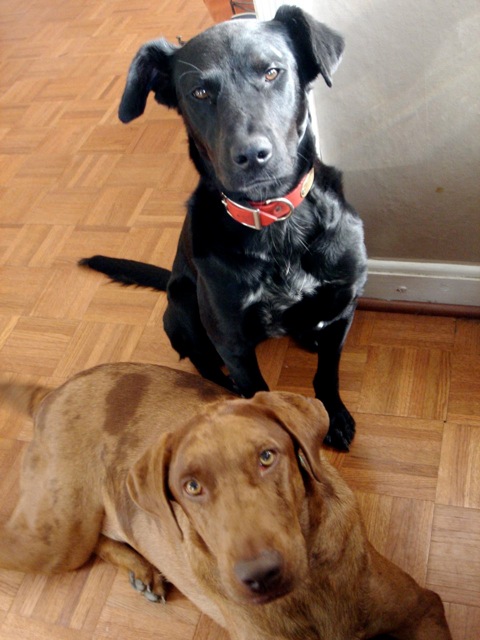
See, when we got our first dog Bessie, we just went to a shelter one day, found a pretty cute pup who seemed playful and friendly, and took her home. There was some puppy chewing of throw pillows and Playstation controllers, but for the most part, she was a freakishly good dog– well behaved, friendly, easy to get along with. Naturally, we thought this was all our doing. We’d go to other people’s houses and encounter unruly dogs who jumped up or begged for food or used the bathroom in the house, and we’d leave thinking to ourselves, what is wrong with them? They’re clearly doing a terrible job as pet parents! We’d think, if only they were as good as we are, they wouldn’t allow that behavior.
Then we got a second dog.
Olive, it turns out, is a vastly different dog, despite our clearly superior dog parenting abilities. In the years we’ve had her, we’ve been completely unable to teach her not to put her paws on us or attempt to climb in our laps or onto the furniture, both places she isn’t allowed. We have had to come to a very shocking conclusion: it’s not that we’re amazing dog owners, we just had a really amazing first dog.
This is a realization I think more first time parents need to come to. It’s a realization we’ve come to yet again as we parent twins who, at every turn, seem determined to remind us that they are very distinct individuals. It started when Claire began sleeping through the night on her own at about 3 months old. Etta still hasn’t mastered that feat. Baby sleep in particular seems to be an area in which everyone fancies themselves an expert. Particularly if they have one kid, the baby equivalent of a Bessie dog, they’ll happily tell you that all you need to do is exactly what they did, and you too will have a baby who sleeps through the night. I hope their next baby is an Olive, every time. Because even though we use the exact same techniques and parenting styles on both of our girls, one sleeps and one doesn’t. We can’t anymore take credit for Claire’s awesome sleeping abilities than we can the blame for Etta’s lack thereof.
The same thing happened with food. Claire took happily to purees quite easily (around 6 months), while Etta has always refused to let us spoon feed her. Several months later, at 10 months, and Etta has only recently decided that while she still hates purees, she’ll willingly chow down on any food she can hold in her own fist. Truly baby-led Baby Led Weaning. I can’t take credit for how either of my girls eats, really, either– they each just do their thing, and I figure out what that thing is through trial and error.
So, you parents of one baby who think you’ve got the whole sleeping and eating figured out through your superior skills? Your kid is probably a Bessie. The next one just might be an Olive.
This is a repost from last year, but since I always enjoy exposing the fallacies we learn as facts in school, here is my Columbus Day post again:
Today is Columbus Day. I’m sure we all learned it in school: “In 1492 Columbus sailed the ocean blue.” That’s probably the only true part of the story we were told.
He didn’t do it to prove the world is round, as that was already pretty widely accepted at the time. He did it to find a sea-based trade route to China. And he didn’t “discover” America. A) The Natives technically discovered America first, and B) Even other explorers, like Leif Ericsson for example, got here first, and C) At best, he landed in The Americas, not North America. And even after he arrived in the Americas, he refused to believe he hadn’t actually reached Asia, despite his utter inability to find any of its great cities. And on top of all that, he was kind of a terrible person and a horrible racist, and his “discovery” unleashed all kinds of horrors on the so-called New World, with the men under his command raping and robbing the natives, and ultimately enslaving them. He even took natives back to Europe as a sort of “show and tell” (because of course, he didn’t think they were really human), and many of them didn’t even survive the voyage.
And before we excuse him based on the fact that tons of people of his time found his behavior, and the behavior allowed under his command, perfectly acceptable, I have to mention a guy truly worth celebrating today. Bartolome de las Casas. De las Casas was originally a participant in the system of exploitation that was quickly set up under Spanish rule in Hispaniola, but he later became a priest, and became convinced that this exploitation was contrary to his Christian faith. Now, this was truly unique, as everyone at the time was a Catholic, and here he was telling them that they were all wrong, and that they were understanding this Jesus guy all wrong. De las Casas became an advocate against slavery, and largely thanks to his work, Pope Paul III forbade slavery in 1537 (shocking how much earlier that happens than it did in the US), and Emperor Charles V followed suit in 1542.
Here are some of the horrors de las Casas saw in the New World that made him such an anti-slavery advocate:
The Spaniards did not content themselves with what the Indians gave them of their own free will, according to their ability, which was always too little to satisfy enormous appetites, for a Christian eats and consumes in one day an amount of food that would suffice to feed three houses inhabited by ten Indians for one month. (37)
The most powerful ruler of the islands had to see his own wife raped by a Christian officer. (37)
They attacked the towns and spared neither the children nor the aged nor the pregnant women nor the women in childbed, not only stabbing them and dismembering them, but cutting them to pieces as if dealing with sheep in the slaughterhouse. (37)
They made some low wide gallows on which the hanged victims’ feet almost touched the ground, stringing up their victims in lots of thirteen, in memory of Our Redeemer and his Twelve Apostles, then set burning wood at their feet and thus burned them alive. (37)
With still others, all those they wanted to capture alive, they cut off their hands and hung them around the victim’s neck, saying ‘Go now, carry the message,’ meaning, Take the news to the Indians who have fled to the mountains. (37)
It’s enough to make you sick at your stomach, right? What Columbus unleashed on the New World is not worthy of celebrating. He should not be made into a hero for children, because he was a corrupt man pursuing his own wealth at the expense of the lives and suffering of others. Instead, we should celebrate people like de las Casas, who came to realize what he was participating in was deeply deeply wrong, and took action that actually led to change. That’s so much more exciting and rare than a Columbus Day Sale.
All quotes come from Bartolome de las Casas’ “The Devastation of the Indies” in the Norton Anthology of American Literature, Seventh Edition, Volume A.
While driving home from school today, I was thinking to myself about all of the stuff I’ve been reading this semester. I’m taking a women’s lit seminar and a “literature of the Americas” seminar (Latin American and Native American) and really enjoying the readings for both, which has stirred up a lot of thoughts. I realized, in a sort of meta way, that I tend to think almost in essay form. I’m not sure if it’s because of all the school I’ve had, or if I like all this school precisely because I’m constantly composing essays in my head, but my musings tend to become thesis statements and paragraphs in my mind. Of course, the problem is, I rarely get a chance to write them down, what with actual assignments to do and something about two babies to take care of….
But, I do have a blog, and I can at least get down these essay embryos and maybe one day return to them and turn them into something if I want.
One of my most striking realizations stems from re-reading The Awakening by Kate Chopin. It’s the story of an 1800s wife and mother experiencing a literal awakening to herself and her place in the world and her realization of her profound unhappiness the more she gets to know herself. When I read this novel for the first time, I believe I was a college freshman. I was 18, and it was a purely academic exercise. Now, I’m reading it nearly 10 years later as a wife and mother, and I’m practically a completely different person reading a completely different book.
Upon first reading, I vaguely remember feeling sad for Edna Pontellier, but I didn’t really understand her in any meaningful way. She wasn’t a very sympathetic character to me, and I found her largely selfish and annoying. She has a live-in nanny, for crying out loud, and she’s supposedly stifled by her role as a mother?! Of course, she’s still a little annoying, with her privileged white girl problems, and I think even Chopin would admit her protagonist is selfish (though how hilarious is it that Edna reads Emerson, perhaps the paragon of selfish male introspection, and he doesn’t get such criticisms). However, now I have a much greater personal window into Edna’s frustrations, even as I realize that maybe it’s precisely because I read The Awakening and other books like it before I became a wife and mother that I largely do not share her pain.
It is precisely because of characters like Edna Pontellier that my greatest fear before becoming a mother was that I would somehow lose myself. Edna argues with the great mother-figure of the book, her friend Adele, about what she would be willing to give up for the sake of her children, baffling Adele with her insistence that while she would give up her life for her children, she would not give up her self. Adele does not understand the difference. And of course, Edna does not understand Adele’s happiness, either, unable to comprehend that a woman who sees almost no distinction between herself and her role as a mother could be truly happy and fulfilled.
The problem for Edna is not that there is something inherently wrong with being a wife and a mother, or that no woman can be fulfilled in those roles, but that not all women are, and for Edna, there were few other options. She is not an Adele Ratignolle, joyfully consumed by her children, but neither is she content to remain a single woman like musician Mademoiselle Reisz. For all her supposed failings as a mother, the Edna we see in the novel is a woman who deeply loves and is very tender with her children. One scene that stands out is her tender rocking of her child to sleep when “the quadroon” is unable to get him to bed. She misses them when they are absent at their grandmother’s house. She would miss them were they not in her life at all.
She is a woman of privilege, even has the much-coveted “room of one’s own” in which to paint, and the childcare to give her time to do so and to think and wander the city as well, and yet she has no meaningful activity outside of her home, and no one in her life who truly understands her. She is a woman who favors the relationship of motherhood but is not well suited to the jobs of motherhood, a distinction made in this very compelling post from Ask Moxie.
Unlike Edna, perhaps because of Edna, I have remained determined to finish my graduate education and continue pursuing my dream of being an English professor. Because of Edna, I know how crucial it is that I get time away from my girls to tend to my other interests, because it makes me a better person and therefore a better mother. Because of Edna, I am grateful for a marriage to a partner who knows me deeply and loves me as a person, not for any prescribed roles I might fill. Unlike Edna, I got to go to college and get to know myself, to become an adult on my own terms before I became a wife and mom, and to discern what it is I want to do with my life and how to define my place in this world. Unlike Edna, I have options.
Somewhere between reading The Awakening for the first time and reading it for the second, I have had many, many awakenings that have made this experience of Edna’s story completely different from my experience the first time around. And in that difference, and in the difference between her life and mine, there is much much gratitude.
Yesterday we walked with the babies in their stroller to vote at our polling place at a nearby church. The people working the polling place, our neighbors, were all happy to see the babies. They were admired and complimented and pushed around in their stroller while we marked our ballots. One poll worker said, “You brought them to a room full of grandparents!”
We headed home, enjoying the beautiful, sunny, not-too-hot day. Occasionally I could smell the gardenia bushes in people’s yards as we passed. Early summer is one of my favorite times of the year here.
As we walked home, we started to hear sirens. At least five police cars roared past us, and we soon realized they were heading to the street one over from ours. Before long, the street was blocked off, and more and more first-responders arrived.
It turns out two people died one street over yesterday. A robbery ended in death for both a victim and a suspect. A tragedy all around.
This makes me a little uncomfortable, because this is my neighborhood. And this is just another incident, like people getting carjacked at the nearby bar, or people getting shot at the nearby EZ Mart, that makes people say it’s not a safe place to live.
In a conversation recently, we told someone where we live, and he said he wouldn’t live here. He chooses to live in the ‘burbs because “crime hasn’t learned to use the freeway.” Really? I’m pretty sure people still get hurt and robbed and raped and killed even in suburbia. And I’d be statistically more likely to die in a car accident on my way to the ‘burbs than to be shot right here in my city neighborhood. And please don’t suggest I get a gun…I’d be statistically more likely to shoot someone I didn’t intend to than someone I did.
Our pastor Ryan wrote a great post about how we respond to violence in our neighborhoods. In answer to his post, I just have to say, we’re staying. We love our house, and we love our neighborhood.
Sure, occasionally bad things happen here. But I’ve yet to see the news report on all that is good. Like the way people hang out on their porches and stop to chat and invite you over for a cold drink. Or the way a neighbor found our dog when she got out and got hit by a car, and Jon and I were both out of town, so he took care of her. Or the way even a new resident threw a spaghetti party for our whole street. Or the love we’ve been showered with since the babies arrived, in the form of pies and free yard work. Or the eggs we get from the neighbor with chickens. Or the fact that the guy next door loves our dogs so much, he put a gate between our yards so they now have twice the yard to play in.
If you think my neighborhood is a scary place to live, you’re missing out on all that is good here that vastly outweighs what is bad.
Last year was a bad tornado season for those of us who live in Tornado Alley. Bad enough that we spent several nights in our “safe space” waiting for the sirens and the winds to stop. A friend had a tornado knock a tree onto her house. Other friends survived the tornadoes that blew through Birmingham and Tuscaloosa. It freaked me out enough that I finally made a FEMA-recommended tornado kit to keep in my safe space, which is small comfort when I know that if a tornado really does hit my house, no waterproof bag full of food and supplies can save me. Tornadoes are scary. They are unpredictable. They are deadly. And climate change seems to be making them worse.
This year has already seen several tornadoes. People have died. Communities have been destroyed. Others are just now starting to pick up the pieces.
Now, let me say right now that I believe in a powerful God who could cause tornadoes if God wanted to. But I also believe that sending these storms wouldn’t be in keeping with the nature of the God I have come to know and love.
I believe that the best way to learn about the nature of God is through the Person of Jesus Christ (as Brian McLaren called it at a talk I attended, you could say my hermeneutic is Jesus). And the God revealed through the person of Jesus is not someone who capriciously sends tornadoes that pick up babies and carry them for miles and kill them. The God revealed in Jesus is someone who wakes up in a boat in the middle of the storm and calms it. The God revealed in Jesus is someone who raises the dead and heals the sick and comforts the grieving and gets to know the outcast. God isn’t someone who breaks and destroys, but someone on a mission of healing and wholeness and reconciliation and redemption.
In the wake of deadly tornadoes, God is on the side of the folks wiping away tears and giving hugs and listening to the grieving and picking up the pieces. God’s drawing nearer to us through acts of love and healing. At least that’s what I believe.
Yes, we live in a world that does not work the way God designed it to. There were no deadly tornadoes, no death at all in fact, in God’s original plan. But all of creation was given the ability to turn from that design, and we did, and here we are. But God isn’t smiting us. God is working to fix it, and God invites us to be a part of the healing. At least that’s what I believe.
I’m praying for the people in Indiana and Kentucky who are dealing with devastation right now. I want them to know that God is on their side.
It’s possible I’ve gotten a little spoiled in that I’ve yet to go to an OB appointment alone. Jon’s got a flexible schedule, and he’s been willing and able to go with me every time. Until today, when some very important disaster training coincided with my appointment, and he couldn’t make it. Because I’m spoiled, my stepmom came with me instead. It was an uneventful appointment, and for that I am very thankful. Just a quick check in, a chat with my doctor, and off on my way, with a pat on the back because I’m still gaining the weight I need to for the babies. No bad news in the ultrasound room. No difficulty finding two little heartbeats on the Doppler. No real problems to report except that I’m still insanely insanely tired, and the constant heartburn is a little annoying, but overall I’m pretty happy for 6 months pregnant, which still feels insane to say.
I am so thankful for this uneventful appointment. I’m thankful to have a great team of doctors and nurses and genetic counselors and care coordinators. I’m thankful that, even though Claire will have to be transferred to another hospital right after birth for surgery and care, it’s the hospital where my husband works, right by our house, and one of the best in the country. I’m thankful to have family nearby to take care of all of us.
In short, I guess I’m just feeling really thankful. Possibly because I’m reading One Thousand Gifts, which is a book all about the practice of gratitude as the central practice of the Christian faith, which is a really great read so far, even though I don’t agree with all of it. The author seems to suggest that God causes all things that happen to us, be they joyful or painful, and I just can’t get on board with the idea that God causes things that are bad. That isn’t to say that I don’t believe that God works all things for the good, or that we can’t be drawn nearer to God in all things, or that we can’t learn and grow from every experience that happens to us. But I just can’t agree, though it has been suggested to me by well-meaning people, that God caused, for example, my Claire’s spina bifida. I am sure it will be an opportunity for learning and growth and drawing nearer to God, but I don’t believe God gives anything but good gifts to his children. I can’t believe God would cause disease or suffering and pain and still maintain faith in God. Spina bifida just happens sometimes. Even if you take your vitamins. Even if you say your prayers. Because that’s the way this world works. And God’s heart is broken along with mamas’ and daddies’ when they find out something’s wrong with their baby. And God rejoices when the defect isn’t as bad as it could be. That’s what I believe.
And so, I’m thankful for uneventful appointments, and for hope for the future, and for days when we don’t get any bad news. And I’m thankful for arms that hold me when the bad news comes too.
Image taken by Paul Schutzer, 1961. Via the Google LIFE photo archive.
Today is Martin Luther King Jr. Day. Last year I learned that my state, and many others, officially recognizes both Martin Luther King *and* Robert E. Lee on this day. I wrote to my legislator, but it’s still the case this year. I hope one day to see it changed.
This day is always really interesting to me. I think Martin Luther King Jr. exemplified the teachings of Jesus in a way few others have. However, when we narrow his life’s work only to racial equality, we oversimplify a man whose mission was one of the radical oneness of all of humankind. Though he was most known for his work on behalf of civil rights and racial justice, Martin Luther King Jr. also fought for the rights of the working class, and was passionately opposed to the Vietnam War and for the cause of peace. He advocated for “intersectionality” before it was a cool buzzword, realizing that oppression anywhere is oppression everywhere. He saw that racism is bound up with classism and militarism, and he fought against all of it.
We still have a long long way to go before his dreams for racial justice, equality, and harmony are achieved in this country. I hope you watch or read the “I Have a Dream” speech today, if you haven’t already. But here, on my little corner of the internet, I wanted to highlight a passage from his 1967 sermon opposing the war in Vietnam (link goes to full text), because its prophetic words about peace and the role of the US in the world still need to be heard today:
This is a role our nation has taken, the role of those who make peaceful revolutions impossible by refusing to give up the privileges and the pleasures that comes from the immense profits of overseas investments. I’m convinced that if we are to get on the right side of the world revolution, we as a nation must undergo a radical revolution of values. We must rapidly begin the shift from a thing-oriented society to a person-oriented society. When machines and computers, profit motives and property rights are considered more important than people, the giant triplets of racism, militarism and economic exploitation are incapable of being conquered.
A true revolution of values will soon cause us to question the fairness and justice of many of our present policies. On the one hand, we are called to play the Good Samaritan on life’s roadside, but that will be only an initial act. One day we must come to see that the whole Jericho Road must be changed so that men and women will not be constantly beaten and robbed as they make their journey on life’s highway. True compassion is more than flinging a coin to a beggar. A true revolution of values will soon look uneasily on the glaring contrast of poverty and wealth with righteous indignation. It will look across the seas and see individual capitalists of the West investing huge sums of money in Asia, Africa, and South America, only to take the profits out with no concern for the social betterment of the countries, and say, “This is not just.”…This business of burning human beings with napalm, of filling our nation’s homes with orphans and widows, of injecting poisonous drugs of hate into the veins of peoples normally humane, of sending men home from dark and bloody battlefields physically handicapped and psychologically deranged, cannot be reconciled with wisdom, justice, and love. A nation that continues year after year to spend more money on military defense than on programs of social uplift is approaching spiritual death.
don’t let anybody make you think that God chose America as his divine, messianic force to be a sort of policeman of the whole world. God has a way of standing before the nations with judgment, and it seems that I can hear God saying to America, “You’re too arrogant! And if you don’t change your ways, I will rise up and break the backbone of your power, and I’ll place it in the hands of a nation that doesn’t even know my name. Be still and know that I’m God.”
We shall overcome because the bible is right: “You shall reap what you sow.” With this faith we will be able to hew out of the mountain of despair a stone of hope. With this faith we will be able to transform the jangling discords of our world into a beautiful symphony of brotherhood. With this faith we will be able to speed up the day when justice will roll down like waters, and righteousness like a mighty stream. With this faith we will be able to speed up the day when the lion and the lamb will lie down together, and every man will sit under his own vine and fig tree, and none shall be afraid because the words of the Lord have spoken it. With this faith we will be able to speed up the day when all over the world we will be able to join hands and sing in the words of the old Negro spiritual, “Free at last! Free at last! Thank God Almighty, we’re free at last!” With this faith, we’ll sing it as we’re getting ready to sing it now. Men will beat their swords into plowshares and their spears into pruning hooks. And nations will not rise up against nations, neither shall they study war anymore. And I don’t know about you, I ain’t gonna study war no more.
Yes, I’m cribbing Lexus’ slogan, because seriously, I don’t know ANYONE who gets cars as Christmas presents (though, Santa, if you’re reading, you know where my driveway is).
Last December was one of the worst months of our lives. I got the flu. Not the “flu” but the actual want to die, 8 days of 102 fever, entire month of sickness, influenza. The kind some people actually die from. (Side note: GET A FLU SHOT.) For weeks, I existed in a sweaty, shivery, coughing, bruised ribs, fluid in my lungs, drugged on codeine haze. Jon was working nights and spending his days dosing me, feeding me, helping me use the bathroom without fainting, and trying to catch some sleep in there too. It’s good to be married to an ER doc when you’re deathly ill, as he took great care of me. He admitted that a few times I looked so bad he thought about taking me to the hospital, but knew they’d pretty much just be doing for me what he was already doing– fluids, NSAIDs, cough meds, Mucinex. In retrospect, I might have needed a chest x-ray, but we survived. (My ribs were sore for a month afterward from all the coughing.)
Little did we know that Jon would be the one to wind up in the ER. One day, when I was finally starting to feel like I might be able to leave the house again, I got a text message from Jon saying that if I was up, he was now a patient in the ER where he had been working, and could I come there, please? He was having a weird heart beat and mentioned it to another doc he was working with, who checked him out, hooked him up to some monitors, and realized he was in atrial fibrillation. Basically, the top chambers of his heart were fluttering around instead of beating in a steady rhythm. Ultimately, it took an overnight stay in the ICU (where I tried desperately not to cough around any of the nurses, because I didn’t want to be kicked out of the unit), where he was the most lucid patient I think those nurses have ever treated, and some hardcore meds to get his heart back into a normal rhythm (they call this “converting” if you want to know some new medical speak). He was mere hours from being shocked with the paddles when the meds finally did their job. We got to look at his heart on the echo, which was pretty cool, to see the heart of the one I love, beating on a screen, but they didn’t establish what caused the a-fib episode. I have a feeling it was the exhaustion of working and taking care of a very sick wife. He hasn’t had an episode since.
Still, as a result, our December last year? While it was one to remember, it was also a pretty sucky one. I’m counting this year as a do-over. I got my flu shot, I’ve been washing my hands like a maniac, and if someone sniffles around me, I’m moving across the room. I’m pregnant, but I’m feeling good. My birthday and hopefully the Baby B gender reveal are coming up on the 16th. I’m looking forward to spending Christmas with my family and New Year’s in Colorado with Jon’s, and we’re determined to be healthy for all of it. Now I just have to figure how to decorate our house in a way that won’t immediately be destroyed by the wild and crazy Tinycat.
I shared this story last year, and thought I’d share it again this year. Every time I look at the painting hanging over my piano, I think of the veteran I’ve never met:
Today, 11/11/11, is Veteran’s Day. I make no bones about the fact that I’m a pacifist, and as a result, Veteran’s Day is a bit problematic for me. I sometimes find the language surrounding it disturbing, and I’m leery of ever praising violence. I’m also leery of saying certain conflicts are about protecting “our” rights and freedoms when they really have nothing to do with our rights and freedoms at all, as is the case in our more recent wars and conflicts. Still, I have family currently serving in the military, and, like most Americans, I have a long family history of people serving in the military, and I am thankful for the sacrifices men and women in the armed forces make for our nation. I know we as a nation don’t take as good of care of our Veterans as we should, and I pray that we can do better. I also pray for a day when no one will need to take up arms in service of our nation.
That said, today, I wanted to write about a particular veteran. One I’ve never met.
My Great Uncle Albert, my father’s father’s brother, is something of a family legend. I’ve heard about him and my Pops growing up in downtown Hot Springs, Arkansas, where their mother ran a boarding house in the height of the town’s “Sin City” days. Mobsters, including Al Capone, spent time there, and the Milwaukee Brewers spent their spring training there. I’ve heard about how a mobster once saw them playing baseball with a stick, and bought them brand new bats with their names engraved on them. Another time, a Milwaukee Brewers player saw that they lacked a proper baseball and bought them an entire case of balls.
My Pops and Uncle Albert sold homemade newspapers to earn money to go to the movies. Then somehow, this boy from Arkansas found his way into some major Hollywood pictures himself. He appeared, uncredited, as a child actor in “Boys Town,” “Angels with Dirty Faces,” “A Star is Born,” “Tom Sawyer,” and “Nothing Sacred.” As a teenager, he lied about his age in order to join the Air Force and serve in World War II. He became a tail gunner, and he served until he was shot down in England, where he is buried.
After his death, his mother received a collection of his paintings from his painting teacher. She never even knew he was a painter.
I wish I could have known him. I’m sure he was a riot, and full of stories. Instead, I have stories others tell about him, and I have one of his paintings:
The man in this painting was my Great Uncle Albert's painting teacher.
I know Veteran’s Day is supposed to be for the living, and Memorial Day for the dead, but I wanted to share my Great Uncle today. Thank you to all Veterans. I look forward to a future where actors and painters can be actors and painters, not soldiers.




 This is a repost from last year, but since I always enjoy exposing the fallacies we learn as facts in school, here is my Columbus Day post again:



 erniebufflo's south & west kitchen