
This started out as a bullet point in today’s “bufflo tips,” but then I realized I had a whole lot more to say on the subject than could be tied up nicely in a sentence or two.
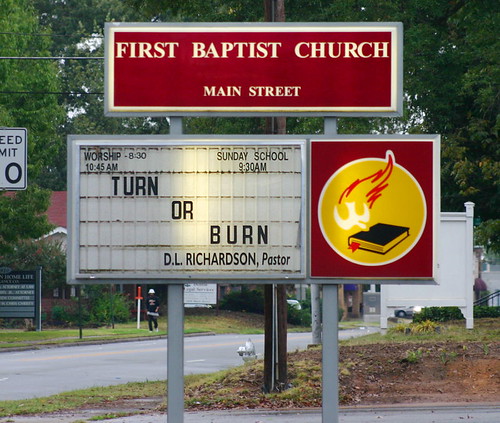
This post by Courtney E. Martin at The American Prospect about the much-hyped Pew study on Americans’ religiosity or lack thereof, was very interesting to me as a Christian. In particular, this portion of the report on why so many people have recently left the faith:
About half … became unaffiliated, at least in part, because they think of religious people as hypocritical, judgmental or insincere. Large numbers also say they became unaffiliated because they think that religious organizations focus too much on rules and not enough on spirituality, or that religious leaders are too focused on money and power rather than truth and spirituality.
In particular the bit about rules over spirituality speaks to me in ways similar to the kinds of things I have been reading and thinking lately. How have we, who claim to follow a Savior who told us that his yoke (his list of rules, each rabbi had one) is easy and his burden is light, become known for our Pharisaical emphasis on rules rather than for echoing our Savior’s emphasis that following him leads to a right heart from which right actions automatically flow? Again I’m going to pimp Dallas Willard, who argues against our petty gospels of “sin management.” We should be known for freeing people of their burdens, not for adding to them with lists of rules, because without the life-transformation that comes from being a disciple of Jesus in the truest sense (not merely an intellectual agreement with the idea that Jesus is Lord and died for our sins, but truly a modeling of one’s life to be like Christ), following the rules is impossible.
Also, Martin writes:
The report, which indicates that one-fourth of adult Americans have changed their religious affiliation from what they were raised with, also explains, “The unaffiliated population is a very diverse group. Not all those who are unaffiliated lack spiritual beliefs or religious behaviors; in fact, roughly four-in-ten unaffiliated individuals say religion is at least somewhat important in their lives.”
I would say this is definitely true for me. If you asked me today, I’d probably claim “unaffiliated.” I grew up in a Presbyterian, PC(USA), church in which I was very active, and for which I am very thankful. I was encouraged to ask questions, to learn about theology and church history, and even to doubt. I attended PC(USA) churches in college, and now that we have moved far far far from home, we sporadically attend an Episcopal church and go to a small group hosted by a Baptist church. Even though I’m not attending church services as regularly as I did growing up, I’m reading my Bible more than ever and also reading books about theology and Christian living. In particular, Rob Bell, Brian McLaren, and Dallas Willard have been topping my reading lists. For the time being, I’m experiencing remarkable spiritual growth also remarkable because it’s taking place outside of a church. Continue reading “some thoughts on the state of church (and state)”







 erniebufflo's south & west kitchen